Friday, April 15, 2011

Flirting With Despair

I’ve been strolling along the edge of despair lately. Or so it feels. A handful of voices, past and present, have been calling me back from (or are they edging me closer to?) the brink. Elizabeth Scalia (aka the Anchoress) wrote a reflection, Another Long Lent, and Broods of Vipers, earlier this week that was featured in the On the Square section of the First Things website. She points to all of the scandals and rumors of scandals that continue to plague the Church, then reminds us to look up. The One that we follow, the only one who will never let us down, is Christ. He (in union with the Father and the Holy Spirit) is the proper focus of our faith, not any of the Church’s human members.

Her words were reassuring.

Then I read some of the comments and was brought back to the edge of despair.

Then there’s Patrick Madrid’s contribution, Don’t Be Discouraged. Subtitled “Hold Your Head Up High, This is a Great Time to be Catholic,” the Envoy Special Report comes complete with an illustration of a band of Christians praying in the stadium dirt as hungry lions and tigers are released to do what hungry lions and tigers do to helpless humans. Patrick has two essays, one on what we can learn from St. Francis DeSales and one on common excuses for not evangelizing. His message seems to be something akin to “Man-up and accept your mission! It might be a tough time to be a Catholic, but do it anyway! If you aren’t suffering like the saints, you should be!”

This is supposed to be comforting?

A significant portion of my temptation to despair stems from the realization that, as our country hurtles toward a debt crisis like a car speeding toward an abyss, we are incapable of doing anything about it. While a handful of politicians frantically try to slam on the brakes, it has become evident that the brake lines are ruptured, and their efforts result only in the spurting of fluid on an over-heated engine. I desperately want to believe that enough of my fellow Americans are awake to the danger to make avoiding the catastrophe possible. Unfortunately, as Peter Robinson recently learned from conversations with Mark Steyn and Tucker Carlson, too much of the electorate is on the receiving end of government largesse, and they are not inclined to give it up.

My thoughts have turned from whether there will be a reckoning to when. If we’re lucky, it won’t be for another 15-20 years, but any perturbation could spark the panic. If you thought 2008 was fun, just wait until the next big financial crisis arrives. I don’t know what happens then, but it fills me with dread.

And that is exactly what Wormwood wants.
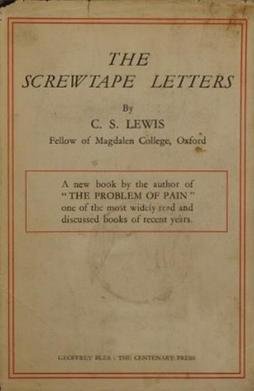
Yes, I’ve been reading The Screwtape Letters, by C. S. Lewis. In the 15th letter, Wormwood is advised by his uncle, Screwtape, to keep his man’s attention on either the past or the future, whether a future of hope or of anxiety. Anything that takes his attention off of the present will do, so long as he is not “aware that horrors may be in store for him and is praying for the virtues, wherewith to meet them.” Preparing for tomorrow doesn’t count, either, since the duty to prepare is today’s duty.

So, then, my task is to remain focused on embracing and fulfilling God’s will today, to pray for the virtues that I will need tomorrow, and to make preparations. If I had the resources, I think I would be building and stocking my bunker.

Wednesday, April 6, 2011

Vincent's Pope

Yesterday was the feast day for St. Vincent Ferrer. His feast day rolls around every year on April 5, although it wouldn’t be observed if it were on a Sunday, during Holy Week, or during Easter Week. The same could be said of St. Isidore (April 4) or St. John Baptiste de la Salle (April 7). Yet St. Vincent Ferrer got an awful lot of notice this year. It wasn’t a particularly significant anniversary of his death (592 years ago, yesterday), so I am genuinely puzzled as to why he got all of this sudden attention.

I don’t know much about St. Vincent, but I can’t call myself a fan because he got one of the biggest questions of his day wrong.

After Pope Gregory XI died in 1378, the cardinals elected a new pope, Urban VI. When Pope Urban VI didn’t do what the cardinals expected him to do, they tried to invalidate his election and elect a new pope who took the name Clement VII. There were two men who claimed to have been elected Bishop of Rome – one of them had to be an anti-pope. St. Vincent Ferrer backed Clement VII. St. Catherine of Siena supported Urban VI. Both St. Vincent and St. Catherine were Dominicans, and indeed, the whole Dominican order fractured at the time.

Eventually, there were three claimants to the papacy, which was reduced back down to two at the Council of Constance in 1415 and finally to one in 1429 (ten years after St. Vincent’s death). Today, most Catholic scholars acknowledge that Urban VI was legitimately elected and that the Office of St. Peter was handed down through his successors. In other words, St. Vincent was backing the wrong horse. Nevertheless, 36 years after his death, Vincent Ferrer was canonized by Pope Calixtus III.

The main things that I draw from this episode in Church history are that even a saint, with all the gifts of grace and holiness that is implied in that title can make wrong judgments; and making a wrong judgment about a person does not necessarily reflect negatively on an individual’s personal holiness. The most glaring modern example would be the judgment of Pope John Paul II regarding Fr. Maciel, the disgraced founder of the Legionaries of Christ.

It follows from this that I am wary of appeals to holiness and legitimacy by association. So, when somebody tells me that an alleged visionary’s confessor was a canonized saint, therefore her visions are legitimate, I immediately think of the counter-examples cited above. Vincent Ferrer might be a canonized saint today, but that doesn’t mean that he didn’t follow the wrong pope during his life on earth.

Thursday, March 31, 2011

Treadmills and Comfy Pews

Over the last several years, I’ve participated in a summer-long 5K racing tour – a series of 3.1 mile races that begins in late April and wraps up in mid-October. Last year, there were 12 races in the tour. The knowledge that the next race is coming up, along with some competitiveness as points add up in the age categories, keeps me running through the summer.

My experiences with training and racing have led me to draw many parallels between running and the spiritual life. Last year was a bit of an off year for me, as I expected it would be. Even with my lowered expectations, I couldn’t help but be a little disappointed in my race times and general performance.

I’m a heavy runner. Through most of last year, I tipped the scales at about 230 lbs. By the end of last year’s tour, my knees were ready for a rest. Around mid-November, I started running on a treadmill at the local YMCA. I reasoned that the flex of the deck would be easier on my joints than the unyielding pavement. Plus, I’m a fair-weather runner, easily deterred by snow, ice, and temperatures that numb exposed flesh. I’ve been running indoors almost exclusively, mostly on the treadmill, for four months now. It’s been a long, cold winter.

I know that the day is fast approaching when I will have to venture back out onto the roads. It just doesn’t seem right to pound out miles on a treadmill when a beautiful day is happening on the other side of the window glass. Even aside from that, though, I’ve discovered that there might be another reason to hop off the treadmill.

Jeff Smith, aka Coach Jeff, produces The Running Podcast Coach Jeff has been coaching and training athletes for 26 years. On a recent podcast, he fielded a question from a listener regarding long distance training runs on a treadmill. Now, when they say long distance, they’re talking about 1-1/2 to 2 hours. That’s much longer than anything I do. Even when I’m ramping up for the Oktoberfest 10K, my longest runs are in the 6.5 mile range and last just under one hour. Still, the Coach’s response was interesting.

The problem with running on a treadmill, according to Coach Jeff, is that there is no variation. Every foot plant is the same, and that can lead to repetitive motion injuries. I never would have guessed that what I was assuming to be less jarring and therefore less injurious to my joints could harbor unknown dangers.

That’s where the spiritual parallel drops into place. The equivalent of the treadmill might be what we can call “the comfortable pew.” The phrase comes from a book of the same title written over 40 years ago and referenced by our pastor emeritus in a recent homily at our clustered parish. We Catholics can become complacent, lured into thinking that just coming to mass every Sunday and parking ourselves in a pew is sufficient. It isn’t. While there is something to be said for stability and perseverance, the mindless repetition of any pious devotion brings with it the risk of complacency and presumption.

Sunday, March 27, 2011

Knicker Knotting Translations

Have you heard about the new translation that's been in the news? There is, of course, the new English translation of the Roman Missal, which takes effect in the United States this coming November. That's been in the news for about a year now, and will continue to be in the news right up until, and probably several months after, its use begins. However, there's been another new translation in the news recently.

In January, the New American Bible Revised Edition (NABRE) was released. The NABRE is the fourth edition of the New American Bible (NAB), which is the translation on which the Lectionary readings used for mass are based. There are a handful of differences between the NAB translation and the text used in the Lectionary, most notably in Luke 1:28, where the angel Gabriel's greeting to Mary is translated as "Hail, favored one!" in the NAB and "Hail, full of grace!" in the Lectionary. The Revised Standard Version (RSV) that I favor uses the "full of grace" translation, with a footnote. My understanding is that neither translation captures the full meaning of the Greek.

Some Catholics have their knickers in a knot over the NABRE. Again, I'm no expert, but my understanding is that the NABRE differs from the NAB only in the translation of the Old Testament and Psalms. Of particular concern to the knicker-knotted is the choice of words for Isaiah 7:14, where the phrase "the virgin shall be with child" has replaced "virgin" with "young woman." There might be problems with the new translation, but I can't get too worked up about this one. Why? Because my RSV translation already reads, "Behold, a young woman shall conceive and bear and son, and shall call his name Immanuel." With a footnote, of course.

The footnote for a "young woman" states that other sources use "virgin." The ambiguity comes from the fact that the oldest copies of Isaiah 7:14 in Hebrew use a word meaning "young woman," whereas the oldest copies of Isaiah 7:14 in Greek (i.e., from the Septuagint) use a word meaning "virgin." The translators have simply chosen to place greater emphasis on the Hebrew texts than on the Greek ones.

Regardless of the translation used for Isaiah, the translation used in Matthew 1:22, which references Isaiah 7:14, still uses the word "virgin." It seems to me that the evangelist implicitly endorses the Greek translation of Isaiah found in the Septuagint, with a collateral endorsement of the deutero-canonical books of the Septuagint.

I'm not likely to run out and buy a new NABRE Bible. But as long as it has the footnotes that identify where alternate sources use different words, I don't think it's anything to knot my knickers over.

Wednesday, March 9, 2011

Render Unto Millard Fillmore

Tuesday’s Gospel reading (the last for Ordinary Time until June) saw the Pharisees and Herodians trying to embroil Jesus in a tax controversy. Jesus asked to see a coin, which was stamped with the image of Caesar. Noting that the image on the coin was Caesar’s Jesus replied to his questioners that we should render unto Caesar the things that are Caesar’s and unto God the things that are God’s.

I had two quick thoughts, one serious and one light. The first is that the coin was created by the Roman government in the image of Caesar. The human person, on the other hand, is created by God in His image. In one sense then, when we talk about what should be rendered unto God, we can speak of the entire human person.

In a lighter sense, I wondered what it would be like if Jesus asked a modern American for a dollar coin. The image on the coin might be Milllard Fillmore, Rutherford B. Hayes, Sacajewea, or Susan B. Anthony, among others. It just wouldn’t do to say, “Render unto Millard Fillmore the things that are Millard Fillmore’s.”

Friday, March 4, 2011

The Withered Fig

What are we to make of the fig tree in today’s gospel reading from Mark? On my first reading, I’ve always see it as a warning to us, that we had better bear fruit. Interpreting the fig tree this way, though, causes Jesus to come off as capricious and petulant for cursing a tree that is not bearing fruit when it isn’t even in season.

As usual, however, there’s much more going on here than is initially apparent. Consider the timeline given by Mark. On the first day, Jesus comes into Jerusalem, spends some time at the Temple, and then retires to Bethany. On the second day, Jesus returns to Jerusalem, cursing the fig tree on the way, then enters the Temple and chases out the vendors and money-changers. Again, he retires to Bethany. On the third day, he again heads for Jerusalem, and the disciples notice that the fig tree is withered.

Note that the timeline in Matthew 21 is a little different. I’m not going to try to deal with that right now. I’m concentrating on the fig tree.

In both gospels, the cursing of the fig tree is within the context of the cleansing of the Temple. It seems clear to me, therefore, that in this instance, the fig tree represents not the individual believer, but the Temple and the Old Covenant system of sacrifices associated with it. The Temple might appear outwardly healthy and might have born fruit in the past, but its days have come to an end. The withering of the fig tree foreshadows the destruction of the Temple.

There are, of course, other questions that are raised by Mark’s account. Why does he note that Jesus was hungry? Why does Jesus cleanse the Temple on the second day and not the first? Is it possible that Jesus was hungry because he had spent the first day and night in fasting and prayer, seeking guidance from the Father regarding what to do about what he had seen in the Temple on the first day?

I dunno. I’d love to hear some reasonable theories. The only thing that I have left to say is that I find some of the arguments that Jesus cursed the fig tree as a demonstration of his power or that his hunger was merely the supposition of the disciples to be unconvincing.

Thursday, March 3, 2011

Lenten Expectations

Lent is nearly upon us. It comes late this year, with Easter falling on April 24th (the first Sunday after the first full moon – April 18th – after the first day of Spring – March 20th). My wife recently proclaimed, “I can’t believe it’s almost Lent already,” to which I (predictably) replied, “It’s late this year.”

As strange as it might be to say, I’m looking forward to finally entering the season of Lent. I am sorely in need of an extended period of penance. Having said that, I fear that I am once again setting myself up for disappointment. My desire for conversion, repentance, and renewal does not guarantee a spiritual experience and response on my part. Although I might want to be moved, that does not mean that I will be moved. Unfortunately, recent Sunday homilies on kindness and affirmation, going the extra mile, and Bobby McFerrin’s Don’t Worry, Be Happy just haven’t met my spiritual needs.

Where does the desire to be contrite end and true contrition begin? I pray that contrition is more than, or at least not dependent upon, emotional sorrow, for my emotions have failed me. Instead, let it be an act of the will. Let true contrition be indicated not be feelings, but by actions to atone for and separate oneself from sin.

By that measure, the success of my Lent will be entirely up to me (although a little spiritual consolation would surely help).

Wednesday, February 9, 2011

There's No App for That

I was at the YMCA this morning when an acquaintance came into the locker room and announced that the Catholic Church had approved an i-phone app for confession. I stated my incredulity, but he insisted that the Vatican had approved it because he had just heard about it on the radio.

This reminded me of a case several years ago when a European company set up a telephone hotline to hear confessions by phone. That one did not meet with Church approval. I told my acquaintance that I would have to look it up, and that it was probably not confession, but an examination of conscience.

BINGO!

First, the app in question was approved not by the Vatican, but by a bishop in Indiana. Second, the app does not replace confession, but can be used by a penitent to assist in examining his conscience before entering the confessional.

Fox News reports:

The app is not designed to replace going to confession but to help Catholics through the act, which generally involves admitting sins to a priest in a confessional booth. Catholics still must go to a priest for absolution.

Little iApps said Bishop Kevin Rhoades, of the Diocese of Fort Wayne in Indiana, officially authorized the app for Catholics to use.


I can’t help but wonder how many Catholics (and non-Catholics) have been fooled into thinking that either (1) they can purchase an application for their mobile device that will absolve them of their sins; or (2) that “the Church” would approve the sale of such an application.

Monday, February 7, 2011

The President's Abortion Statement

It seemed like an amazing statement at the time, and I was sure that somebody else - a professional writer far more capable than I of forming thoughts into coherent sentences - would jump all over it. However, in the two weeks following the anniversary of the Roe v. Wade decision, in which the Supreme Court made killing one's unborn child a Constitutional right, I haven't seen it noted by any of the pundits and prognosticators that I read regularly.

President Obama chose to frame his statement this year around what would appear to be a misunderstanding of the Catholic principle of subsidiarity. The Acton Institute defines it this way: "This tenet holds that nothing should be done by a larger and more complex organization which can be done as well by a smaller and simpler organization. In other words, any activity which can be performed by a more decentralized entity should be." President Obama, in his statement, said, "Government should not intrude on private family matters."

This is absurd nonsense! The government intervenes in cases of domestic violence on a routine basis, and quite justly so. It is hard to imagine a surgical abortion as anything other than an act of violence. What makes state intervention imperative when the victim is a spouse or a child, but forbidden when the child is unborn? Indeed, if a pregnant woman is assaulted and the baby in the womb dies, the person responsible will be charged with a crime for the death in addition to the assault.

When the British Empire ruled India, so a commonly cited anecdote goes, an upper-class Indian man died, and his body was to be burned. It was customary, the local British official was told, to burn the surviving widow with the dead body. The official replied that Britain also had a custom of hanging any man who burned a woman alive. "You carry out your custom, and we shall carry out ours," he said.

The principle upon which President Obama claims to base his acceptance of abortion, if logically extended, would likewise require acceptance of things like honor killings, infanticide, and euthanasia - so long as it is kept within the family. It is a misunderstanding of subsidiarity and a concept foreign to the Common Law principles upon which our system of jurisprudence is based.

Either he hasn't thought through the implication his own stated principles or, worse yet, he has.

Thursday, January 27, 2011

Augustine's Commentary on Hebrews

I went trawling around the internet last week to see if there were any public domain commentaries on the Letter to the Hebrews. My heart leapt when I saw in the search engine results a commentary by St. Augustine, apparently available through the on-line library at Ave Maria University.

Hooray, I thought. Augustine is a Father and Doctor of the Church. If I can trust anybody to explain the text to me, surely it is Augustine. I should have known that I was setting myself up for disappointment

First disappointment: the commentary only covered the first six of thirteen chapters. There would be no words of wisdom from the Doctor of Grace on that thorny section of Chapter 10 that the Lectionary skips over.

Second disappointment: I flipped ahead to see what Augustine had to say about paying careful attention in verse 2:1, and I found the language of the commentary to be extraordinarily dense. I don’t mean that in any pejorative sense. I mean that if you’re not used to reading this kind of writing (and I’m not), your eyes quickly glaze over and you start babbling in the corner. This commentary is not something that you’re going to pick up to get a quick read on the meaning of a particular passage. You (or should I say I?) would have to start several verses earlier and read several verses past and then really concentrate on thinking about what the words mean. It’s not a discipline that’s common in our culture of tweets and text messages and 15-second sound bites.

On the other hand, there is a section in the prologue where Augustine acknowledges that some scholars (even then!) doubted that Paul was the author of the Letter to the Hebrews. He then lays out his reasons for believing that the author was indeed Paul. I remain firmly agnostic regarding the identity of the letter’s human author. The question might have been important in deciding whether or not the letter belonged in the Canon of Scripture, but it was included and it’s not going to be removed. Folks far smarter than I can argue both sides – I’m content to trust the Tradition (capital “T”) of the Church. In the meantime, I’ll try to suppress my urge to shout, “We don’t know that!” every time a homilist asserts that Paul was certainly not the author.

[UPDATE 7/30/2014:  The hyperlink is broken, and it appears that the URL in the link pointed to a commentary by Aquinas rather than Augustine.  At the time that I wrote this post, I was certain that it was Augustine, but this would not be the first (or last!) time that I was mistaken.]

Monday, January 24, 2011

Called to Obscurity

Can any serious Christian say that they haven't at some point asked in prayer what it was that God wanted of them? Conversion is usually accompanied by a desire to serve - to surrender oneself to the will of God. This sentiment was clearly expressed by Blessed John Henry Newman:

God has created me to do Him some definite service; He has committed some work to me which He has not committed to another. I have my mission—I never may know it in this life, but I shall be told it in the next. Somehow I am necessary for His purposes, as necessary in my place as an Archangel in his—if, indeed, I fail, He can raise another, as He could make the stones children of Abraham. Yet I have a part in this great work; I am a link in a chain, a bond of connexion between persons. He has not created me for naught. I shall do good, I shall do His work; I shall be an angel of peace, a preacher of truth in my own place, while not intending it, if I do but keep His commandments and serve Him in my calling.


The mission that He has for us is often not what we expect or desire, and those he chooses for a given mission are not always those that we, in our human wisdom, would choose. Why did He choose Simon the Zealot to be an apostle and not his friend Lazarus? Why James, the son of Alphaeus, and not Nicodemus? Why the tax collector Matthew and not the tax collector Zaccheus? Simon Peter felt unworthy: "Depart from my Lord, for I am a sinful man." Yet, he ultimately left his fishing business to follow Him. The rich young man just couldn't bring himself to do the same.

When we turn our life over to Him, we expect to make big sacrifices. We tell Him that we'll go wherever He wants us to go and do whatever he wants us to do, all for the greater glory of God. When we discern his will, though, we sometimes find that He is telling us to go home. It's not what we expected to hear, and at first, it's disappointing. After Jesus cast the demons out of the Gadarene demoniac, the young man wanted to follow Him, to become one of his disciples. Instead, Jesus sent him home.

We should not be disappointed to be sent home, for our mission there is no less important. St. Therese compared the obscure missions to the little violet flowers in God's garden:

I understood this also, that God's Love is made manifest as well in a simple soul which does not resist His grace as in one more highly endowed. In fact, the characteristic of love being self-abasement, if all souls resembled the holy Doctors who have illuminated the Church, it seems that God in coming to them would not stoop low enough. But He has created the little child, who knows nothing and can but utter feeble cries, and the poor savage who has only the natural law to guide him, and it is to their hearts that He deigns to stoop. These are the field flowers whose simplicity charms Him; and by His condescension to them Our Saviour shows His infinite greatness. As the sun shines both on the cedar and on the floweret, so the Divine Sun illumines every soul, great and small, and all correspond to His care—just as in nature the seasons are so disposed that on the appointed day the humblest daisy shall unfold its petals.


Having a mission at home is not easy. We are called to be faithful in the little things and to instill in the most mundane chores an abundance of love. We trust that God gives us all of the grace that we need to accomplish our mission. And yet, it almost seems as though faithfulness in the small things is harder. The invisibility of obscurity makes it all too easy to adopt the prevailing morals and practices of the culture.

Every Christian is called to the apostolate. Those called to the apostolate of parenthood are just as much in need of prayers as those who have received high-visibility missions.

All you holy saints in heaven, pray for us!

Wednesday, January 19, 2011

Restoring the Queen

My home parish (not where I now reside) was recently featured in the local newspaper for the restoration of some artwork within the church. Holy Angels parish is where I became baptized, made by First Communion, received Confirmation, married my wife, and saw my first three children baptized. When I was a child, my family always sat on the left side of the church, and I can remember looking up the side aisle at the mural of Mary surrounded by a flight of angels. I don’t remember when it happened, but at some time, the mural disappeared and all the statues turned brown.

Now, after thirty years, the mural is back, and the color is gradually being restored to the statues. The original intention in concealing the mural was to avoid distracting the faithful from the sacrifice at the altar. Clearly, the experiment disproved the hypothesis – the art was not the distraction that some thought it to be, and removing is did nothing to focus the attention of the faithful gathered at mass on the primary work of the liturgy.

I am delighted to see the restoration taking place at Holy Angels and pleased to see it covered by a secular newspaper.


Pay Careful Attention

We are a week back into Ordinary Time. Every other year, the first four weeks of Ordinary Time feature readings from the Letter to the Hebrews during weekday masses. Again and again, the author of the letter makes his point by referencing the scriptures, which were for him what we call the Old Testament. In the first chapter alone, five different psalms are cited, plus Deuteronomy and 2 Samuel.

The second chapter begins with the exhortation, "We must pay more careful attention, therefore, to what we have heard, so that we do not drift away." (Hebrews 2:1) It is a caution that we are no less needful of hearing today than the Hebrews of 2000 years ago were. Catholics are infamous for not reading their Bibles. Even those that do can easily read the text in a superficial manner, glossing breezily over the knotty passages as if they don’t exist. We tend to have the attitude that the Church, under the guidance of the Holy Spirit, has already figured all of that stuff out for us, so we don’t really need to bother. That’s true to an extent.

But (you knew there was a “but” coming, didn’t you?), we’re talking about Divine Revelation here. The scriptures are the record of God’s self-revelation to us. They matter, because it is by studying them and coming to a better understanding of them that we arrive at a better understanding of the divine mind. Ignorance of scripture is similar to ignorance of history. It is only my knowing the mistakes of past generations that we can hope to avoid making those same mistakes.

Even more important is the idea of a divine pedagogy. The events of salvation history were not accidental. They built upon one another until, in the fullness of time, the Word became flesh and dwelt among us. The New Testament does not exist in isolation from the Old.

There are plenty of false prophets who preach a Christ that is at variance with what is recorded in the Word of God. If we hope to be able to spot the differences, we have to pay more careful attention, lest we drift away from what is authentic.

Sunday, January 16, 2011

The Infancy Timeline

Last Saturday, my wife and I were driving to a nearby parish to attend mass for the Solemnity of Mary, Mother of God. The next day, we would be observing the Epiphany, and I took the opportunity to share with her a theory that I have regarding the appearance of the magi in Bethlehem. She looked at me a bit askance, and accused me of trying to start my own religion. I assured her that I have no intention of doing that, and that if I ever veer from orthodoxy, I hope somebody cares enough to correct me.

The fact is that our conception of what happened at the birth of the Messiah is driven, in large part, by the popular devotion that is the nativity scene. Last weekend, just before the nativity scenes were removed from our churches and homes at the end of the Christmas season, we saw a scene in which Mary and Joseph were adoring the infant in the manger, surrounded by animals, shepherds, and royal magi. The theory that alarmed my wife so much was that I don't think the magi showed up until months or even a year after Jesus was born.

I've come to that conclusion because I'm trying to make sense of the differences between Matthew's gospel and Luke's. Like a detective in a modern-day police drama, my mind is trying to lay out the discreet scenes in the gospels into a timeline. Matthew's gospel really doesn't treat the Nativity at all, proceeding from Joseph's dream in 1:20-25 to the appearance in Jerusalem of wise men from the East in chapter 2. Luke, on the other hand, explicitly covers the birth, with the appearance of the angels to the shepherds in the field, and the shepherds proceeding that same night to the manger. Luke then relates that on the eighth day after his birth, Jesus was circumcised, and on the 40th day he was presented at the Temple in Jerusalem.

The magi must have found the Holy Family some time after the Presentation. Matthew tells us that the wise men followed the star not to a stable or cave, but to a house. Therefore, Joseph and Mary must have decided to settle in Bethlehem, the city of David, in order to raise an heir to David's line. It was after the magi departed that the angel warned Joseph to take Mary and Jesus to Egypt. I very much doubt that, in fleeing Herod's wrath, Joseph would have led them on a detour to Jerusalem. Herod, in his rage, ordered the slaying of all male children in the region of Bethlehem who were two years old and younger, not just the infants. And it was only after Herod's death that Joseph led the family back to settle in Nazareth.

I'm not going to be changing my nativity scene anytime soon. When we set it up next year, we'll still have Mary and Joseph adoring the manger, which will be empty until Christmas Eve, when the Christ child is added. The ox and the ass will look on, while an angel hovers overhead and shepherds bring their sheep. Three wise men and a camel will be placed some distance away until the second Sunday after Christmas, when they'll join the party at the manger. Even though it didn't really happen that way.

Tuesday, December 14, 2010

Zephaniah and God's Judgment

I had to search through my Bible a bit to find the book of Zephaniah. He’s not one of the prophets that I can say I know much about, and the book of his prophecy is only three chapters long. Wanting to justify my unfamiliarity, I did a quick search of the Lectionary, expecting to find that today was the only day that his book is referenced. I was wrong. I found entries not only for Tuesday of the 3rd Week of Advent, but also December 21, the 3rd Sunday of Advent (Cycle C), the 4th Sunday of Ordinary Time (Cycle A), and the Feast of the Visitation of the Blessed Virgin Mary on May 31. I have no excuse.

Zephaniah’s prophecies, we are told at the beginning of the book, were delivered during the reign of King Josiah, the last good king of Judah. Josiah’s great-grandfather, Hezekiah, was king of Judah during the fall of the northern kingdom of Israel. Hezekiah was faithful to the Lord, but grew proud. Hezekiah’s son and Josiah’s grandfather, Manasseh, was wicked. He repented and was forgiven, but it was Manasseh’s reign that sealed the doom of Judah (2 Kings 21:10-15). Josiah turned back to God and instituted reforms throughout Judah, but God had already decided Judah’s fate, and Zephaniah’s prophecy seems to bear this out.

What piqued my curiosity was that, although Judah’s fate was decided during Manasseh’s reign, God’s hand was stayed during the reign of Josiah. It took two generations before God’s judgment was made manifest, first through Neco of Egypt and then through Nebuchadnezzar of Babylon. That would be like America today suffering for the sins of the Johnson or Nixon administrations.

Lest you think the comparison is far-fetched, consider that we’ve been living for 39 years with a legal framework that makes abortion-on-demand a constitutional right. Marriage is under attack and the traditional two parent family is becoming the exception rather than the norm. Vague spiritualities are displacing doctrinal Christianity. Nevertheless, there are signs of light. They have stayed the hand of God all these years, and they are not going to vanish quietly into the night.

I cannot help but wonder, in my darker moments, whether the fate of our land has already been decided. America has had its moments as a shining city on a hill, conceived in liberty and blessed by the Almighty, but then so did Judah and Israel. It’s a nice country we’ve got here; it would be terrible if something bad were to happen to it.

I don’t mean to suggest that God is extorting us. What I mean to suggest it that the fate of our country is in our hands. We are in a continuing state of crisis, and the only thing that will stay the hand of God’s judgment is our fidelity. God promised Abraham that Sodom would be spared if only ten righteous men could be found there. Sodom was destroyed.

Monday, December 13, 2010

Advent Confirmation

It’s been over a week now since my oldest child was confirmed. Our retired archbishop came up from Cincinnati to celebrate the rite. For the last several years, ever since the last auxiliary bishop fell ill, our parish’s sophomores have been confirmed by the local dean, which makes it a bit awkward for those catechists who have taught that the ordinary minister is a bishop.

It just so happens that the maiden name of the archbishop’s mother was the same as my surname. However, in one of those ironies that is all too common in this neck of the woods, he is more closely related (through his mother) to my wife than to me. Before my wife and I could be married, I had to trace back the family tree to establish that I was fifth cousins with my future mother-in-law.

Although alternate readings that emphasize the effects of the sacrament are approved for use during the Confirmation liturgy, the readings for the Second Sunday of Advent were used. The gospel was not entirely inappropriate for the occasion, including as it did this line from Matthew 3:11: “I baptize you with water for repentance. But after me will come one who is more powerful than I, whose sandals I am not fit to carry. He will baptize you with the Holy Spirit and with fire.”

The archbishop delivered one of his canned Confirmation homilies, in which he examines the candidates by asking questions, but provides the answers himself in a catechetical style. The archbishop has a subdued delivery. It’s not a monotone, but five minutes after he’s spoken, you have a hard time recalling what it was that he said. I would be surprised if any of the confirmandi was inspired by his words to take up sword and shield (metaphorically speaking) as a soldier of Christ.

I suspect that, for my sixteen year old son, the memory of the day has already begun to fade, just as my memory of my own Confirmation is foggy at best. Nevertheless, he is sealed with the gift of the Holy Spirit. He has been claimed, and he allowed himself to be. That is something that I have no intention of letting him forget.

Wednesday, December 1, 2010

Surprised by Faith

It's easy to think of Him as more than human, especially if you already subscribe to a high Christology. In one class that I took, another student admitted to thinking of Him as a kind of superman. First, of course, there are the miracles. Then there are the confrontations with the Pharisees, in which He seems to know what their thinking, like a comic book hero with telepathic powers. Padre Pio was said to have been able to read souls, and it's not unreasonable to assume that any spiritual gifts possessed by human saints would also be present, par excellence, in the incarnate Word.

It is also possible, however, that he came by this knowledge in a human way, through observation and deduction. Maybe Jesus "knew" what the Pharisees were thinking in the same way that a really good Republican strategist "knows" what a Democrat partisan thinks.

We are confronted by this human limitation, present in the human nature of Christ, in Matthew 8:10. In the middle of the account of the encounter between Jesus and the centurion is the statement that Jesus "marveled" (RSV), "was amazed" (NAB), or "was astonished" (NIV). The centurion's statement of faith was, apparently, not what Jesus expected.

The Church selected this gospel passage for us to hear on the first Monday of Advent, the day after we heard Isaiah proclaim that all nations would stream toward the mountain of the Lord's house. In the centurion, a gentile official of an occupying power, Jesus found a faith that was lacking in the tribes of Israel. Perhaps this was a sign to Him that the age of the Old Covenant was drawing to a close, and the time had come to initiate the New Covenant.

Friday, November 19, 2010

Facebook Temptations

Is Facebook a force for evil or a force for good? Am I being too much of a squish if I say yes to both? Joe Carter at First Thoughts provides both sides in commenting on a New Jersey pastor’s decision to ban Facebook for married leaders of his congregation. The pastor claims that over the last six months, 20 couples at his congregation have experienced marital problems due to the social networking website.

I’ve been on Facebook for two years now, and I’ve very much enjoyed reconnecting with old friends and acquaintances. It is certainly true that some users do not seem to recognize any boundaries between what should be private and what should be public. Most status updates are innocuous enough, but there are also those that run the gamut from heartbreaking to sad to offensive to tantalizing. Some of my old friends live a life style that I, as a middle-aged husband and father of seven couldn’t and shouldn’t share.

Clearly, there are options for dealing with temptations on Facebook. We can ignore the posts. We can pray for the poster. We can block a person’s updates from appearing on our feed. We can delete the person from our list of friends. Yes, we can also go all the way to deleting our own Facebook account and decline to participate.

Christians, however, are not called to separate themselves from society. We are to act as a leaven. In terms of Facebook, that means that we should sail the waters but navigate within safe boundaries. It is similar to other media through which temptations enter our lives: cable and broadcast television, popular music, glossy magazines, the world wide web, etc. Where Facebook is different is that the flow of content runs both ways.

Others might see the stability, virtue, and dare I say, joy that is present in the life of a practicing Christian, even (especially?) when undergoing adversity and be led to question their own misconceptions. If the biggest barrier to conversion is the scandal of Christians behaving badly, then perhaps the best counter to that is the example of Christian’s living well. In many cases, the only exposure that the worldly are going to get to an authentically lived Christian life is through our status updates. If we all quit Facebook, then they won’t even get that.

Wednesday, November 17, 2010

Bring Them Here . . .

Did you catch that second-to-last verse from today’s gospel (Luke 19:11-28)? We’ve often heard different versions of this parable, but Luke’s version doesn’t appear to be read at any Sunday mass, even in Cycle C, which draws mainly from the gospel of Luke. If I were a betting man, I would be willing to wager that most Catholics have never heard this gospel passage. Jesus is telling this parable because some of his followers think that he is going to Jerusalem to establish his kingdom. It is as if he is saying, through the parable, “No, not now. I have to go away for a while first.”

In the parable, what happens to those who rejected the authority of the king while he was gone? “But those enemies of mine who did not want me to be king over them – bring them here and kill them in front of me.” (Luke 19:27). Lest a reader think that the harshness of this passage is an isolated case, I note that the agreement with the Book of Revelation’s letter to the church at Sardis (read at mass yesterday) is chilling: “Yet you have a few people in Sardis who have not soiled their clothes. They will walk with me, dressed in white, for they are worthy. He who overcomes will, like them, be dressed in white. I will never blot out his name from the book of life…” (Rev 3:4-5). None of us should be willing to risk having our name blotted out from the book of life.

Oh, yes, the Lord is kind and merciful, slow to anger and generous in forgiveness. But he is also just. Love of God is paramount, but a little fear (the proportionate awe that keeps our pride in check) is a good and necessary thing.

Tuesday, November 16, 2010

Today, Zacchaeus

Most of us, I think, are familiar with the story of Zacchaeus. It’s a popular tale for sharing with children because of the imagery. Zacchaeus was the curious, but short, tax collector who climbed a tree in order to get a glimpse of Jesus. Jesus spotted him and, much to the scandal of the Pharisees (for tax collectors were considered by the Pharisees to be great sinners) invited himself to dine at Zacchaeus’s house.

What struck me on reading this passage today was the urgency of Our Lord’s response. “Zacchaeus, come down IMMEDIATELY. I MUST stay at your house TODAY.” (Luke 19:5, emphasis added) Zacchaeus had received an extraordinary grace that led him to climb the sycamore tree. He had responded to that grace, but it was a brief moment that wouldn’t last. Jesus recognized that he was looking at a soul on the cusp of conversion. We have phrases in English that fit the moment: “strike while the iron is hot” and “make hay while the sun is shining.” In other words, seize the opportunity of the moment before it passes.

Jesus seized the opportunity to step through the opening and pull Zacchaeus out of himself, and Zacchaeus responded with an act of great generosity and renunciation of sin. “TODAY salvation has come to this house,” Jesus declared (Luke 19:9, emphasis added). We can imagine the joy of the occasion.

As Christian disciples, we must strive to be prompt in responding to the gentle prods of the Holy Spirit. Zacchaeus was open to the good news on that day in a way that he would not have been later in the week. Collecting his contact information and promising to follow up in a few days would have delivered the hammer strike after the iron had cooled and was less malleable. Annanias had to respond promptly to complete Paul’s conversion. Ambrose had to be there to complete Augustine’s conversion.

We have to respond TODAY, both for ourselves and for others. Zacchaeus was saved on the day that he opened the door of his soul because Jesus came through that door on the same day. We are both Zacchaeus and bearers of Christ’s love. Our response is required TODAY. Tomorrow might be too late.

{Disclaimer: My own response record is pathetic. That doesn’t discredit what I’ve written above. It just means that I need to open myself up more than I have in the past.}

Monday, November 15, 2010

Malachi 3/4

Late last week, I decided to look ahead to the Sunday readings. I was using my NIV pocket bible at the time, and I couldn’t find Malachi 3:19-20. After verse 18, chapter 4 started. “Darn Protestant bible,” I thought to myself (being the arrogant Catholic that I am. “I didn’t know that they cut out part of Malachi, too.”

So I pulled out my Ignatius Bible (RSV-CE), and it, too, went from Mal 3:18 to Mal 4:1. OK, I can’t blame the Protestants for excising parts of Malachi. This time, though, there was one of those tiny little footnotes informing me that the verses of chapter 4 were part of chapter 3 in the Hebrew. I was getting confused, so I checked my Catholic Youth Bible (NRSV), which had in the past given me details on such mysteries as Chapter C of Esther. No luck. All that I got was the same tiny little footnote as was in my RSV.

I mentioned this on Saturday morning at our men’s fellowship meeting, and a friend checked his bible (NAB), and sure enough, it had the verses at the end of chapter 3. I didn’t think at the time to ask whether his bible had a tiny little footnote.

Here’s the big cause for my massive confusion: I was always led to believe that the chapters and verses were added by St. Jerome when he compiled the Latin Vulgate. Were the verses of Malachi numbered in the original? If so, then why don’t all of the translations that are based (to the extent possible) on the original languages follow the Hebrew numbering?

In the grand scheme of things, the numbering of the verses in one of the books of the minor prophets is a trivial thing. Whether they’re in chapter 3 or chapter 4 has no effect on the meaning of the words, it just makes them harder to find. However, it leads to one more head-scratching moment, of which I already have way too many.

Friday, November 12, 2010

Running Ahead

Peter wrote (2 Peter 3:16) that Paul could be hard to understand. I don’t know why he didn’t say the same thing about John. In 2 John 9, we read, “Anyone who runs ahead and does not continue in the teaching of Christ does not have God; whoever continues in the teaching has both the Father and the Son.”

Obviously, there is a development of doctrine that takes place over time. It took over four hundred years for the Church to hammer out the doctrines related o the Holy Trinity and the dual nature (human and divine) of Jesus Christ. We believe that this development is guided by the Holy Spirit.

What I want to be able to say is this: that the development of doctrine does not introduce new elements in to the deposit of faith, but rather clarifies the doctrine to exclude incorrect (i.e., heretical) interpretations. Belief in the Immaculate Conception or the Assumption of Mary can be traced back to the apostolic age; belief didn’t suddenly begin when the dogmas were defined in the 19th and 20th centuries. Doctrine might be developed by using schools of philosophy to explain theological truths in new ways, such as when St. Thomas Aquinas used Aristotelian metaphysics to explain the real presence of Christ in the Eucharist (transubstantiation).

Christ himself promised to send the Holy Spirit to lead his Church into all truth. Over time, we have discovered that this works in a negative rather than a positive way. The Spirit does not inspire the Church to proclaim the truth; rather the Spirit prevents the Church from teaching error. This charism of infallibility is focused in the person of the Supreme Pontiff and those bishops who teach in union with him.

Again, as long as we follow the Pope, we should be on pretty safe ground.

As you can probably guess, I tend to look askance at anything that claims to have a new teaching. There are people very dear to me who are involved with a group promoting ideas that are new and supposedly better than anything that has been taught in the 2000 years of Christianity. When asked about this newness, the claim is made that it’s all right there in the scripture (isn’t every heresy?). Amazingly, it took a special revelation for this teaching to be discovered. The Holy See is reviewing it, they claim, and will approve it any day now.

Right. Until that day (I won’t be holding my breath), I think I’ll stick with what I can trust.

Among or Within?

I’d like to make one more comment on Luke 17:21, and that’s related to translational ambiguity. I usually use the Revised Standard Version, but I also reference a pocket-sized New International Version. One translation has Jesus telling the Pharisees that the kingdom of God is “among” them (with a tiny little footnote that says “or within”), while the other translation has the text reading “within”, while a footnote provides the alternate “among.”

I doubt that the alternate choice of words is due to ambiguity in the meaning of the ancient Greek. More likely, I think, is that multiple texts of antiquity have been discovered, and come use on Greek word, while others us a different Greek word, and we simply don’t know which is original. There’s also the possibility that the original gospel was not in Greek at all, but rather Aramaic. (This possibility is endorsed by a very small minority of scripture scholars, based on work done in back-translating the Greek into Aramaic and discovering some interesting word-plays in the resulting text.) No knowing the languages involved, I don’t even know how close the Greek words might be to one another or how likely a transcription or translation error from the Aramaic might be.

In Jesus of Nazareth, Ratzinger (Pope Benedict XVI) argues that “the kingdom of God” should be interpreted as referring to the person of Christ, based partly on the “among” translation of Luke 17:21. Other commentators have argued that “the kingdom of God” is internal to the individual believer – an assertion that would be supported by the “within” translation of Luke 17:21.

It’s one little word, but the type a spirituality that a person follows could be flavored by the word choices used in the Bible that person reads. Unfortunately, we apparently don’t have any way to know what Jesus actually said to the Pharisees. Where the heck is that Q fragment when you need it? I think that I’m on pretty safe ground if I use the same translation as the Pope.

Thursday, November 11, 2010

Signs of the Kingdom

The similarities and contrasts between today’s gospel (Luke 17:20-25) and Sunday’s gospel (Luke 21:5-19) is interesting. Today, we read of Jesus telling his disciples, “The kingdom of God does not come with your careful observation” and “the Son of Man in his day will be like lightning, which flashes and lights up the sky from one end to the other.” On Sunday, we will hear him tell his disciples what signs to watch for: wars and revolutions; earthquakes, famines, and pestilence; fearful events and great signs from heaven.

Do these statements all refer to the same thing? Are we moderns to see these as applying to a past event, our current circumstances, or some time in the future? All three could be true.

The first, about the kingdom defying observation, seems apt in two senses. For approximately thirty years, the Son of God lived among us without appearing extraordinary. Surely, he would have been known as being unusually virtuous, but purely in a human sense. It wasn’t until after his baptism that he began his public ministry, performing miracles in testament to his authority. But he is also present in the Eucharist in a way that defies observation. St. Thomas Aquinas wrote (as translated), “What the senses fail to fathom, let us grasp through faith’s consent.”

What of the lightning in the sky? Lightning flashes briefly, illuminating the darkness and providing a brief moment of stark contrast. Certainly this could apply to the second coming, but it seems to me that it would be equally applicable to the three shocking days of Our Lord’s passion, death, and resurrection. Those three days were like a lightning strike in the history of the world.

As for the wars, earthquakes, and famines, doesn’t the text imply that these are signs of the fall of Jerusalem and the destruction of the temple? I have heard apologists argue from historical records that these things did indeed precede the destruction of the temple.

Interpreting these sayings as referring to the hidden life of Jesus, or the Eucharist, or the Paschal Mystery, or the Siege of Jerusalem does not rule out other interpretations. They could be interpreted as references to the second coming of Christ at the end of time. We cannot know the date, and looking for it won’t hasten it or make it immanent. When it happens, we’ll know it. It will not be a secret; rather, He will come in glory. Reading the signs of the times can be a risky business. Paul, without contradicting Christ, wrote to the Thessalonians that the second coming would occur at a time of peace and complacency.

Wednesday, November 10, 2010

Leo the Great

Today is the memorial of Pope St. Leo the Great. Not only is he recognized as one of the great popes, he is also one of the Doctors of the Church. Leo was bishop of Rome from 440 to 461, and he is responsible for defining the papacy as we've come to know it. Not only did Leo provide much of the theological basis for papal authority, he exercised that authority in governing the Church, resolving disputes between contentious bishops, and establishing the principle that the Church is separate from the state.

Leo famously rode out to meet Atilla the Hun, convincing him not to sack and pillage Rome. He was not so successful with the Vandals, who did enter Rome, but pillaged in a more gentle manner than was their typical mode.

Leo forcefully combatted Christological heresies, such as Nestorianism (that Christ was two persons, one human and the other divine) and Monophysetism (that Christ had only a divine nature and not a human one). He called the Council of Chalcedon to affirm that Jesus Christ was one person with two natures, fully God and fully man. Leo also did all that he could to make life miserable for the non-Christian Manicheans.

It is because of Pope St. Leo the Great that we see the bishop of Rome today as the successor of Peter, the vicar of Christ and the human head of the Church on earth.

Pope St. Leo the Great, pray for us!

Monday, November 8, 2010

The Spiritual Life is Like a . . . Pimple?

Here's one that I'd never heard before. Fr. Stan Fortuna, CFR was a guest on last week's Life on the Rock. About 23 minutes into the show, Doug asks him about overcoming difficulties in the spiritual life, and Fr. Stan proceeds to say that it's like getting a pimple on your nose. Really? The inner life is like a zit?

Grudges and Mustard Seeds

I like to think that I’m not the grudge-holding type. That’s not to say that I don’t observe a person’s behavior and make future decisions accordingly. For example, I once asked a certain friend for help moving a heavy appliance. I will never ask for his help again, even though he remains a friend. That’s not the same thing as holding a grudge.

Judging from the reaction of the apostles in today’s gospel (Luke 17:1-6), grudges were not so easy to let fo of in the Mid-East culture of 200 years ago. For all I know, the problem might persist to this day.

Jesus says something in today’s gospel that shocks the apostles. He tells them first that temptations to sin are sure to come; then that the one through whom the temptation comes is doomed; finally, that they must forgive any sins committed against them. The first two seem reasonable, but the third causes the apostles to beg for more faith.

As I sit here thinking through the meaning of this passage, three possibilities come to mind. First, the temptation and woe verses could be tied to the story of Lazarus and the rich man (Luke 16:19-31), which they immediately follow. The problem here is that it’s hard to tie the source of temptation to any figure in the Lazarus tale. Second the temptation and woe verses could be a stand-alone aside. Such an interjection, however, would seem to interrupt the flow of Luke’s narrative. I have no doubt that some scholars who subscribe to the theory of Markan Priority and the existence of the mysterious Q document probably see this as the most likely explanation.

A third option, however, is that Jesus is drawing a connection between the temptation and its source to the one offended by the sin. In that case, did my brother sin against me because I tempted him to, or is his sin against me a temptation to me to sin in retribution? Is the forgiveness that I extend to my brother for my benefit or his? Is this one of those cases where the answer is not either/or, but both/and?

When the apostles object that their faith is insufficient, Jesus responds that they only need a little: “If you have faith as small as a mustard seed, you can say to this mulberry tree, ‘Be uprooted and planted in the sea,’ and it will obey you.” Was it a statement of encouragement or frustration? Letting go of the grudge was more than the apostles could imagine.

Even if I can extend forgiveness to others more readily than the apostles , that gives me no cause to look down upon the them. I have my own obstacles that keep me from fully embracing the holiness that is the human vocation. In my imagination, I can picture Him telling me sadly, “If you have faith as small as a mustard seed,…”

Friday, November 5, 2010

Planning for the Future

I have a daughter with Down syndrome who is integrated into the first grade at our local school. The intellectual impairment that comes with Down syndrome can range over a fairly wide spectrum. I would estimate that Erin’s intellectual ability fall in the upper middle of this spectrum – I believe that she’s a little more capable than most children her age with Down syndrome, but she’s still considerably less capable than her typical peers, and she has a stubborn streak that causes occasional difficulty.

My dear wife has great hopes for the amount of independence that Erin will eventually achieve. I, on the other hand, have resigned myself to the expectation that Erin will always be dependent upon us to a significant degree. Naturally, I wonder what will happen as we, and Erin, grow older, especially if a time comes when we are unable to provide Erin with the assistance that she needs. Two recent stories related to this concern caught my attention.

First was a segment that aired October 8 on NPR’s All Things Considered. The report told the story of how Al Etmanski, the father of a daughter with Down syndrome, helped to create, and is now the president of, the Planned Lifetime Advocacy Network (PLAN). PLAN’s mission is to “help families secure the future for their relative with a disability and to provide peace of mind.” The organization works to help parents plan for both the social and financial future needs of their special needs children.

The second story was featured in the October 20 issue of the Arlington Catholic Herald. Gabriel Homes is a private nonprofit organization with seven homes in the Arlington, Virginia area. Their mission is to promote “independence through residential placement, training, and community integration for adults with mental retardation.” The biggest problem for Gabriel Homes is that their waiting list is twice as large as their capacity, and they typically have only one opening per year.

PLAN is in Canada and Gabriel Homes is in Virginia. With Erin in only the first grade, I haven’t seriously looked at what might or might not be available here in west central Ohio.

Two Cents on Midterm Election Recriminations

In the wake of the midterm elections, there is some renewed discussion out there regarding the Buckley Rule and the perceived weakness of the Republican Senate candidates in Delaware and Nevada. I wish to contribute my two cents.

Penny one: the Buckley Rule. William F. Buckley famously remarked that his vote in a particular election would go to the most conservative viable candidate. I happen to think this rule should be applied to the actual vote at hand – a primary vote should not be projected forward to the general election. I refuse to cast a primary vote based on a candidate’s “electability” as proclaimed by mainstream media pundits. Isn’t that how the Democrats ended up with John Kerry as their presidential nominee in 2004?

Penny two: voting for weak candidates. Sometimes, a vote is cast not because of enthusiasm for Candidate A, but out of revulsion for Candidate B. If I lived in Delaware, I would not have wanted to vote for Christine O’Donnell, but she would have nonetheless been the recipient of my votes against Mike Castle in the primary election and Chris Coons in the general election. If she was unable to expand her support much beyond her opponents’ negatives, the question that really ought to be asked is why no better representative of conservative ideals stepped forward to challenge Castle for the Republican nomination. She at least had the courage to enter the arena.

Thursday, November 4, 2010

Misplaced Prayers

Catholic News Agency (CNA) has a story posted today about a bishop in the Philippines who is attempting to correct misplaced, superstitious Marian devotion.

At first glance, they seem to have great faith – praying fervently, invoking the intercession of the Blessed Virgin Mary, and watching for signs of God’s will. But these apparent signs of piety have a different meaning for some Filipinos. They’re trying to pray their way to a winning lottery ticket.

On reading the story, I was reminded once again of the assertion by St. John of the Cross that even something as good as prayer can be an occasion of sin if done for the wrong reasons. The circumstances surrounding an action can turn something that is almost always good into something that is not good.

There were two other things that caught me attention in this story, though. First was the way my confused brain kept combining “Grand Lotto” into “Grotto.” It’s quite remarkable, given the Marian context of the story. Second was the web ad that appeared next to the story in my browser. The ad was for a site called “Filipino Cupid” – a Filipino dating service – and featured pictures of Asian women in skimpy swimwear. Hardly an ad appropriate for a Catholic news site!

Monday, November 1, 2010

All Saints Collection

Before All Saints Day passes us by, I want to note something with some humor (and just a tint of cynicism). Because November 1st falls on a Monday this year, All Saints Day is not a day of obligation in the United States. Ditto if it falls on a Saturday, and if it falls on a Sunday, it just replaces the ordinary Sunday, which is already a day of obligation. Also, since Monday is our pastor's day off, there was no mass at our parish today, just the usual morning communion service presided over by a deacon. However, there was still a contribution envelope for All Saints Day to put in the collection basket that wasn't passed at the mass the wasn't celebrated.

I'm sure that it's just coincidence, but just yesterday, we received the report from our parish finance committee on collections and expenditures by our parish over the fiscal year just ended. Maybe they can increase donations by printing more envelopes for holy days that aren't celebrated.

In Praise of Podcasts

Have I ever shared with you my enthusiasm for podcasts? I love ‘em! I get the opportunity to listen to programs from C-SPAN that, if I tried to watch on TV, would surely drive my wife and kids from the room, if not prompting a full-scale mutiny to take control of the remote. It is by podcast that I listen to some of my favorite EWTN programs, and they are delivered right onto my computer for me. I am grateful for that, and it occurs to me that I really should send them a donation.

Football Faith

On EWTN’s The Journey Home last week, Marcus Grodi and his guest, Doug Lessels, talked a bit about football. I never played football – I ran cross country in high school – so I naturally relate more to the metaphors that St. Paul uses in his epistles. Football, unlike running, is more of a team sport. The quarterback might be the star, but if his linemen aren’t blocking, he’s going to get sacked. The wide receivers has to run his route in order to be where the quarterback is going to throw the ball, and even if he doesn’t get passed to, he still forces the other team to cover him.

We are all part of the team that is the Church. Paul said that the hand, the foot, the ear, and the eye were all part of the same body, codependent upon one another. St. Therese recognized that in God’s garden, both roses and little white flowers are necessary, and if she was to be a little white flower, her aspiration was to be the best little flower she could be. We all have our gifts; we all have our role to play, and we all have a responsibility to and dependence upon our teammates.

We are not without our coaches and cheerleaders. On All Saints Day especially, we are reminded of those who have taken the field before us and gained entrance to the glorious Hall of Fame. The letter to the Hebrew tells us that we are surrounded by a cloud of witnesses.

So yes, football fits. Baseball fits. Running fits. Sports competition mirrors the spiritual life, and whatever your sport might be, there are important lessons that you can learn from it.

Friday, October 29, 2010

The Libertine Libertarian

Every now and then, some conservative prognosticator gets it in his head to compile a list of something with conservative themes. It could be rock songs, movies, books, fictional characters – you name it, somebody has, or soon will, come up with a list. This fascination with lists is not limited to conservatives. Catholics, especially our friends at L’Osservatore Romano, have contracted the bug as well.

When the list in question is conservative authors of science fiction, one almost always finds Robert Heinlein’s name on the list. Indeed, Heinlein appears to have a large number of fans on the right side of the political spectrum. I read quite a bit of Heinlein in my youth, and I think I know what I’m talking about when I say that Heinlein might have been a libertarian (and a libertine one at that!), but he was no conservative, as I understand the term.

Heinlein’s fiction is not friendly to religion and traditional morality. In Time Enough for Love, the protagonist travels back in time, where he seduces his own mother. In Job: A Comedy of Justice, the characters “marry” into a family with multiple husbands and wives involved in polyamorous bisexual relationships. Also in Job, we learn that the devil is a misunderstood swinger who’s much more fun that the uptight God. Meanwhile, Stranger in a Strange Land presents us with a Christ-like figure from Mars who preaches that “Thou art God” (as is the tree in the meadow, so don’t think too highly about yourself) and instructs his followers to cook him into a soup for dinner after he dies.

I was in my teens when I read most of my Heinlein. It’s a wonder that I turned out as I did (and maybe explains some of the flaws with which I still struggle). I don’t think that my parents had any idea what kind of amorality I was absorbing through my choice of literature. That’s why I try hard to monitor what my own kids are reading.

Heinlein’s stories are fun to read, and they do promote some virtues, such as self-reliance and civic responsibility, but they also promote a world-view that is incompatible with Christian morality. He should only be read by adults capable of recognizing and filtering out the bunk.

Thursday, October 28, 2010

Capital Gains

There was some discussion over on The Corner yesterday between Ponnuru and Stuttaford regarding taxes, specifically, the capital gains tax. I find myself straddling the fence on the subject. Suppose, for the sake of argument, that I buy a house for $100,000 and then sell it for $150,000. There are lots of folks who think that I’ve just pocketed fifty grand and need to share a portion of that windfall with Uncle Sam. This might be true, IF there hasn’t been any inflation AND I haven’t poured any money into the property.

In most cases, however, flipping a house involves spending money to prepare it. In my case, just holding onto an older house involves a constant flow of cash. If I own the above-mentioned house for ten years, and during that time I spend more than $50,000 on it (for re-modeling, upgrades, roofing, plumbing, landscaping, etc.), then it is hard for me to see how that difference between my purchase price and my selling price represents a net gain that the government needs to tax, especially if I can document every penny that I’ve spent on the property.

On the other hand, I’m all for phasing out the mortgage interest deduction. It provides a perverse incentive to buy more house than I need and to keep the value of that house financed rather than owned in equity.

Tuesday, October 26, 2010

Speed Mass

Wow! That was one of the quickest Sunday masses I’ve ever attended. The brevity of the rite was assisted by the terseness of the homily. Here it is, in it’s entirety: “Two men went up to the Temple to pray. One of them did.” I sat in my pew thinking, “That’s a promising start,” but the celebrant spun on his heel and returned to the sanctuary. Just like that, the Liturgy of the Word was over, and we were transitioning to the Liturgy of the Eucharist.

Tuesday, October 19, 2010

Special Days

I’ve fallen a little behind in following the Lectionary readings. While the Church completed reading St. Paul’s letter to the Galatians and moved on to the letter to the Ephesians, I found myself stuck on Galatians 3:15-25. Up until that point,I thought that I was following Paul’s line of argument; but then he offered a clarifying example. Rather than make things clearer, it only confused me more, and I had to keep re-reading the passage. Let’s just say that I don’t find Paul’s reliance on singular versus plural nouns, especially when the noun is something as indefinite as “seed” or “offspring” (depending on the translation) to be convincing.

I finally moved on yesterday, only to stumble over Galatians 4:8-11.

Formerly, when you did not know God, you were slaves to those who by nature are not gods. But now that you know God – or rather are known by God – how is it that you are turning back to those weak and miserable principles? Do you wish to be enslaved by them all over again? You are observing special days and months and seasons and years! I fear for you, that somehow I have wasted my efforts on you.


This October, like no October I ever remember, is being pushed upon us as Breast Cancer Awareness Month. Everywhere I turn, I see pink! Every cause has it’s own awareness month, it seems. And, of course, we observe secularized seasons for Halloween, Thanksgiving, and Christmas. Even within the Church, we observe special months (May for Mary), seasons (Advent, Christmas, Lent, and Easter), years (the Year of St. Paul, the Year for Priests), and days (solemnities, feasts, and memorials). Would St. Paul have feared for us?

I know that Paul was writing in the context of the old Law, which was fulfilled in Christ. Christians aren’t under the Law and, therefore, aren’t required to observe the Law’s liturgical calendar. In some ways, however, we traded one liturgical calendar for another. We are no longer bound by the Mosaic Law, but we are bound by Canon Law. The difference is that we do not become righteous by observing the calendar and the law. Indeed, the righteous will be observant, but not slavishly observant.

What might cause Paul to fear is the sad fact that some might believe that merely by observing the calendar, they are doing all that is necessary. This occurs to varying degrees. There is the Catholic who only attends mass occasionally, but makes sure to go on Ash Wednesday and Good Friday, and thinks that’s good enough. There is the Catholic who attends mass every Sunday and holy day of obligation, but only those days, and thinks that’s good enough. On the other extreme, there are Catholics who, based on promises by apparitions in private revelations, think that they are assured of salvation as long as they make it to mass on nine consecutive first Fridays or first Saturdays, or are wearing a brown scapular when they die.

Ultimately, that is not what saves us. We are saved by faith, but not faith alone. Our faith must be accompanied by love. When James says that faith without works is dead, he is not speaking about works of the Law; he is speaking about works of love. If we observe special days, months, seasons, and years because we love God, the Church, and the object of those observances, then we are doing a good thing, and no fear is necessary.

Wednesday, October 6, 2010

Linked: Newman and Rameses

Disparate things occasionally form tenuous links. George Weigel has a piece On the Square today in which he waxes over the recently beatified John Henry Newman. He quotes a prayer by Newman:

God has created me to do him some definite service. He has committed some work for me which He has not committed to another. I have my mission. I may never know it in this life but I shall be told it in the next. I am a link in a chain, a bond of connection between persons….

The prayer continues, but that idea of being a link in a chain is striking. It is so easy to slip into a mode of thinking in which we exist in spiritual isolation to the extent that our sins and weaknesses are private. They are not, as Paul makes all too clear in his first letter to the Corinthians. A soul’s private sins affect the whole body.

The sudden recognition of interconnectedness is enough to make an individual vow, “I will not be the weak link!” That, in turns brings to mind the scene from the Dreamworks film Prince of Egypt, in which Rameses, rebuked by his father, vows that he will not be the weak link in the line of Egyptian kings. The vow hardens his heart and turns him into an autocratic dictator.

The analogy limps more than a bit. If we all form a single chain, then any one person would only need to ensure that he is not the weakest link – as long as another link fails first, the whole chain fails because of someone else – and we can all look around us and see folks that we believe are weaker links than we are. Nonetheless, it helps to be reminded that we are all joined together. Life is a team sport.

Newman was a historical figure of greatness. The Rameses of film was a fictional character based on a historical figure. It is a good thing for us to be determined not to fail in our obligations to God, but we must always remember that the obligation is manifested in love – both of God and of our fellow man created in God’s image.

Blessed John Henry Newman, pray for us, that we might each fulfill our mission with fidelity and love.

Monday, October 4, 2010

The Number of Sts Simon and Jude

I like to read the Bible with the Church by following the Lectionary readings and trying to fill in the gaps when the readings skip chapters. Last week, for example, the Lectionary skipped its way through the book of Job in six days, five if you exclude Wednesday, when the readings for the Feast of the Archangels superceded those for the 26th Week of Ordinary Time. Once a month, I’ll chart the readings for the month, print the chart, and tuck it into my Bible for reference.

Two things struck me as I prepared my chart for October. The first is that, although we aren’t numerologically superstitious, I couldn’t help but notice that the Lectionary entry for the Feast of Sts. Simon and Jude on October 28 is 666. That also happens to be Beggar’s Night (aka Trick or Treat) in our little village. All Saints Day (November 1) uses Lectionary entry 667, making 666 the last fixed entry before Halloween. I’m sure that it means nothing, but it’s still interesting to note.

The second striking thing is the entry for All Souls Day, November 2. There are three options for the first reading, three options for the responsorial psalm, 13 options for the second reading, and 12 options for the gospel. That’s 1,404 different possible combinations! I think that I’ll just default to whichever four are featured on the USCCB site for that day.

Note: I don’t have my own copy of the Lectionary. I use this site as a reference, with little recourse other than to trust in its accuracy.

Tuesday, September 28, 2010

Redemption Road?

Toyota gave us the swagger wagon with their Sienna commercials, but just what is it that Honda’s trying to sell us in their latest Odyssey commercial? A heavy metal minivan with the path to Redemption Road pre-programmed into the GPS? Redemption from what? The horror of having to buy a gallon of milk? The only thing missing from this commercial is a tramp in fishnet stockings!

I think I’m supposed to be the target consumer for this product, but this marketing offends me. Is this how they think men in the minivan market need to be appealed to? The type of man likely to be swayed by this type of commercial is not going to be caught dead in a minivan, no matter how many fireworks are going off behind it.

Instead, I would have emphasized the cross-platform utility and elegance of the vehicle. Scene 1: transporting a baseball team in the morning. Scene 2: fold down the seats and transport lumber and tools for home projects in the afternoon. Scene 3: a tuxedo and evening gown affair with the wife, complete with valet parking. Leave the heavy metal fantasies to the childish childless.

Saturday, September 25, 2010

1994 Redux

Remember how, in 1994, a wave of conservative legislators were swept into office on the promise of the Contract With America? It’s hard to believe that was 16 years ago. That year coincided with my own spiritual and political awakening. As I came to recognize and embrace the truths of the Catholic faith, I also moved toward political principles that favored subsidiarity, family values, and economic opportunity. 1994 was an exciting year.

I cannot adequately describe the disappointment that I felt when, two years later, the Republicans nominated Bob Dole to be their presidential candidate. I was pleased with the platform written by the Republican delegates at their 1996 convention, but Dole distanced himself from the document, declining even to read it. I took it like a thumb in the eye, and decided that he wasn’t going to get my vote. I wasn’t about to punch the chad for Bill Clinton, so my protest vote that year went to Howard Phillips.

This year, 2010, looks like it will be as big a year for conservative Republicans as 1994 was, and we look forward to evicting President Obama from the White House in 2012. However, I worry that when it comes time to pick a candidate to run against the incumbent, the Republican Party, hot on the heels of a 1994 redux, will end up with a 1996 redux.

Friday, September 24, 2010

Going Easy

The end of my running season is approaching. I could run in a local non-tour 5K this Saturday, but I’m choosing not to. That leaves two races on my calendar. The big annual event in our little village is the Oktoberfest, and it has a 10K (6.2 miles) race associated with it. Lots of locals who don’t run at all the rest of the year will lace up their shoes to run in the Oktoberfest 10K. I join them because a) it’s kind of a big deal; b) a group of my fellow employees enters as a team (we took second place last year); and c) the race features weight divisions (I took first place in the over-220 lb division last year). Therefore, I have to run, if only to defend my fatso class title. That race is a week away. The other race is two weeks after the Oktoberfest, and is the final race in the Shelby County 5K Tour. I haven’t done as well in the tour this year – my times are slower, and I’m out of the running for first place in my age group, but I could still place second, and I have yet to win a door prize this year.

I’ve been averaging about 20-25 miles of training per week, since early April. For serious runners, that doesn’t sound like much, but I’m over forty years old now and over 220 pounds. These days, when I go out for a run, I feel it in my knees. I find myself trying to balance my need to train for the last two races against the need to maintain the integrity of my knees. Once we enter the off-season, I’m going to have to find a lower-impact form of exercise to engage in for a while.

The thought occurred to me this week: I don’t need to run those last two races. That’s certainly true. I’m not a professional athlete. Nothing requires that I maintain a minimum level of physical fitness. I could begin my off-season today. As usual, however, I immediately reminded myself of the spiritual analogy. Nothing requires me to do anything more than comply with the precepts of the Church: attend mass on Sundays and holy days of obligation; fast and abstain on prescribed days; confess mortal sins once a year; receive Communion once a year; and contribute financially to the support of the Church. Nothing requires me to pray Morning Prayer or Evening Prayer (lauds or vespers). After all, I’m not a priest, deacon, or vowed religious. I don’t have to pray the rosary, or make a holy hour, or read the Bible.

It’s not really good to think in terms of only what’s required, though, is it? There are folks who trudge off to the gym to “workout” with the least possible effort. You see them in the cardio room, putting in their allotted time on the stair climber, but supporting themselves the whole time on the rails, with their arms extended and their elbows locked. They do it out of a sense of duty, or to be able to say that they do it, but their heart isn’t really into it. That’s not how I want to exercise. That’s not how I want to pray, either.

I want my prayer to be motivated by love, even if the love has to be willed because the emotion is absent. As for my exercise, well, that’s as close as I get to penitential self-flagellation. It is a training of my self-discipline as much as anything else. “I do not run like a man running aimlessly; I do not fight like a man beating the air. No, I beat my body and make it my slave….” (1 Cor 9:26-27)

Unwanted

The video below was featured at Catholic Exchange and conveys a beautiful pro-life message. The video is part of a collection of videos at Too Many Aborted.com, a site that seeks to educate the public about the impact of abortion on the African-American community.

Thursday, September 23, 2010

Getting the Headline Wrong

I checked the Dayton Daily News headline this morning, and was shocked to see this: “Local economy gets a boost from increased tax revenue collections.” That sounds completely backwards. Are we to believe that increased tax collection actually led to an improved economy? That’s not what the body of the story actually says. According to Dayton’s City Manager, “It’s hard to pinpoint why we are doing a little better on the income tax side, but I think it’s generally because the economy has gotten a little bit better.”

That makes a little more sense. Tax revenues are up because the economy has improved. The headline, however, completely reverses the cause and the effect. This should serve as a warning to any who get their news by scanning the DDN headlines.

Tuesday, September 21, 2010

On a Dry Plateau

How long does it go on?

All summer long, it seems, I’ve been running, and every 5K that I run finds me struggling to finish with about the same time (and that time being about a minute slower than last year). All of my effort seems to be just for maintenance, without any improvement. Shouldn’t I at least be losing weight? Nope. I’m stuck.

I experienced the same thing when I was lifting weights. You hit a plateau where all of the effort in the gym only goes to keep from losing the progress you’ve made. Your muscles aren’t getting any bigger, and the weight you’re moving just isn’t getting any heavier.

The same applies to my spiritual life. I have prayed the Liturgy of the Hours every morning and every evening (along with spontaneous prayers offered throughout the day), and yet nothing seems to change. I ditched the i-pod for a finger rosary when pounding out the miles, but there has still been no closer communion with God. Every confession seems to be a replay of the twenty previous confessions. There is no progress. I’m on a plateau.

But what happens if I stop running, stop lifting, or stop praying? I gain weight, lose aerobic capacity, get weak, and grow distant from God. There are things an athlete can do to break out of a rut. Runners can incorporate interval training, improve nutrition, or take supplements. It might not be as easy to overcome a period of spiritual dryness, as anyone who has read the correspondence of Mother Teresa is aware. In that case, all that we can do is trust in God’s providential love.

So I’m in a rut (or on a plateau), and it’s frustrating, but I don’t dare stop what I’ve been doing. (Actually, I do dare, occasionally, much to my detriment.) What I’m doing now might be the best I can manage, given the circumstances. Even so, I can make adjustments to my physical training or pious practices. The important thing is to hold on to what I’ve worked so hard to achieve (while at the same time remaining detached from the physical and acknowledging that the spiritual is more of a gratuitous gift) without despairing that this just might be as good as it gets.

Thursday, September 16, 2010

Fatherless Connection - Contraception and the Church

A recent blog post or column or whatever by Sandro Magister (and highlighted by Catholic News Agency) commented on a topic that was featured in Brian Gail’s novel Fatherless. In Fatherless, the characters of Joe Delgado and Fr. John Sweeney have to confront the failure of the Catholic Church to stand against the cultural forces pushing contraception on society.

What Magister notes (citing a book by a professor of demography at the University of Padua) is that the problem did not suddenly appear out of nowhere in the 1960’s, but goes much further back. Priests were advised, when hearing confessions, not to ask questions. There was no preaching on contraception, so many of the laity were unaware of the moral issues involved and therefore did not consider it something that needed to be confessed in the sacrament of penance. As a result, it’s use became widespread among the Catholic population, even though it was never accepted by the Church.

The distance between Church teaching and the use of contraceptives continues to be perceived by most of the population as neither a sin nor a rebellion.

Even afterward – and this brings us up to today – the condemnation of contraceptives would be the subject of papal documents, but already at the level of the bishops it would hardly appear in preaching. The clergy, for their part, would be almost completely silent on it. And would continue to be very understanding and indulgent in the confessional.