Friday, April 15, 2011

Flirting With Despair

I’ve been strolling along the edge of despair lately. Or so it feels. A handful of voices, past and present, have been calling me back from (or are they edging me closer to?) the brink. Elizabeth Scalia (aka the Anchoress) wrote a reflection, Another Long Lent, and Broods of Vipers, earlier this week that was featured in the On the Square section of the First Things website. She points to all of the scandals and rumors of scandals that continue to plague the Church, then reminds us to look up. The One that we follow, the only one who will never let us down, is Christ. He (in union with the Father and the Holy Spirit) is the proper focus of our faith, not any of the Church’s human members.

Her words were reassuring.

Then I read some of the comments and was brought back to the edge of despair.

Then there’s Patrick Madrid’s contribution, Don’t Be Discouraged. Subtitled “Hold Your Head Up High, This is a Great Time to be Catholic,” the Envoy Special Report comes complete with an illustration of a band of Christians praying in the stadium dirt as hungry lions and tigers are released to do what hungry lions and tigers do to helpless humans. Patrick has two essays, one on what we can learn from St. Francis DeSales and one on common excuses for not evangelizing. His message seems to be something akin to “Man-up and accept your mission! It might be a tough time to be a Catholic, but do it anyway! If you aren’t suffering like the saints, you should be!”

This is supposed to be comforting?

A significant portion of my temptation to despair stems from the realization that, as our country hurtles toward a debt crisis like a car speeding toward an abyss, we are incapable of doing anything about it. While a handful of politicians frantically try to slam on the brakes, it has become evident that the brake lines are ruptured, and their efforts result only in the spurting of fluid on an over-heated engine. I desperately want to believe that enough of my fellow Americans are awake to the danger to make avoiding the catastrophe possible. Unfortunately, as Peter Robinson recently learned from conversations with Mark Steyn and Tucker Carlson, too much of the electorate is on the receiving end of government largesse, and they are not inclined to give it up.

My thoughts have turned from whether there will be a reckoning to when. If we’re lucky, it won’t be for another 15-20 years, but any perturbation could spark the panic. If you thought 2008 was fun, just wait until the next big financial crisis arrives. I don’t know what happens then, but it fills me with dread.

And that is exactly what Wormwood wants.
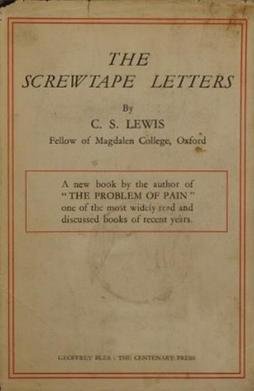
Yes, I’ve been reading The Screwtape Letters, by C. S. Lewis. In the 15th letter, Wormwood is advised by his uncle, Screwtape, to keep his man’s attention on either the past or the future, whether a future of hope or of anxiety. Anything that takes his attention off of the present will do, so long as he is not “aware that horrors may be in store for him and is praying for the virtues, wherewith to meet them.” Preparing for tomorrow doesn’t count, either, since the duty to prepare is today’s duty.

So, then, my task is to remain focused on embracing and fulfilling God’s will today, to pray for the virtues that I will need tomorrow, and to make preparations. If I had the resources, I think I would be building and stocking my bunker.

Wednesday, April 6, 2011

Vincent's Pope

Yesterday was the feast day for St. Vincent Ferrer. His feast day rolls around every year on April 5, although it wouldn’t be observed if it were on a Sunday, during Holy Week, or during Easter Week. The same could be said of St. Isidore (April 4) or St. John Baptiste de la Salle (April 7). Yet St. Vincent Ferrer got an awful lot of notice this year. It wasn’t a particularly significant anniversary of his death (592 years ago, yesterday), so I am genuinely puzzled as to why he got all of this sudden attention.

I don’t know much about St. Vincent, but I can’t call myself a fan because he got one of the biggest questions of his day wrong.

After Pope Gregory XI died in 1378, the cardinals elected a new pope, Urban VI. When Pope Urban VI didn’t do what the cardinals expected him to do, they tried to invalidate his election and elect a new pope who took the name Clement VII. There were two men who claimed to have been elected Bishop of Rome – one of them had to be an anti-pope. St. Vincent Ferrer backed Clement VII. St. Catherine of Siena supported Urban VI. Both St. Vincent and St. Catherine were Dominicans, and indeed, the whole Dominican order fractured at the time.

Eventually, there were three claimants to the papacy, which was reduced back down to two at the Council of Constance in 1415 and finally to one in 1429 (ten years after St. Vincent’s death). Today, most Catholic scholars acknowledge that Urban VI was legitimately elected and that the Office of St. Peter was handed down through his successors. In other words, St. Vincent was backing the wrong horse. Nevertheless, 36 years after his death, Vincent Ferrer was canonized by Pope Calixtus III.

The main things that I draw from this episode in Church history are that even a saint, with all the gifts of grace and holiness that is implied in that title can make wrong judgments; and making a wrong judgment about a person does not necessarily reflect negatively on an individual’s personal holiness. The most glaring modern example would be the judgment of Pope John Paul II regarding Fr. Maciel, the disgraced founder of the Legionaries of Christ.

It follows from this that I am wary of appeals to holiness and legitimacy by association. So, when somebody tells me that an alleged visionary’s confessor was a canonized saint, therefore her visions are legitimate, I immediately think of the counter-examples cited above. Vincent Ferrer might be a canonized saint today, but that doesn’t mean that he didn’t follow the wrong pope during his life on earth.

Thursday, March 31, 2011

Treadmills and Comfy Pews

Over the last several years, I’ve participated in a summer-long 5K racing tour – a series of 3.1 mile races that begins in late April and wraps up in mid-October. Last year, there were 12 races in the tour. The knowledge that the next race is coming up, along with some competitiveness as points add up in the age categories, keeps me running through the summer.

My experiences with training and racing have led me to draw many parallels between running and the spiritual life. Last year was a bit of an off year for me, as I expected it would be. Even with my lowered expectations, I couldn’t help but be a little disappointed in my race times and general performance.

I’m a heavy runner. Through most of last year, I tipped the scales at about 230 lbs. By the end of last year’s tour, my knees were ready for a rest. Around mid-November, I started running on a treadmill at the local YMCA. I reasoned that the flex of the deck would be easier on my joints than the unyielding pavement. Plus, I’m a fair-weather runner, easily deterred by snow, ice, and temperatures that numb exposed flesh. I’ve been running indoors almost exclusively, mostly on the treadmill, for four months now. It’s been a long, cold winter.

I know that the day is fast approaching when I will have to venture back out onto the roads. It just doesn’t seem right to pound out miles on a treadmill when a beautiful day is happening on the other side of the window glass. Even aside from that, though, I’ve discovered that there might be another reason to hop off the treadmill.

Jeff Smith, aka Coach Jeff, produces The Running Podcast Coach Jeff has been coaching and training athletes for 26 years. On a recent podcast, he fielded a question from a listener regarding long distance training runs on a treadmill. Now, when they say long distance, they’re talking about 1-1/2 to 2 hours. That’s much longer than anything I do. Even when I’m ramping up for the Oktoberfest 10K, my longest runs are in the 6.5 mile range and last just under one hour. Still, the Coach’s response was interesting.

The problem with running on a treadmill, according to Coach Jeff, is that there is no variation. Every foot plant is the same, and that can lead to repetitive motion injuries. I never would have guessed that what I was assuming to be less jarring and therefore less injurious to my joints could harbor unknown dangers.

That’s where the spiritual parallel drops into place. The equivalent of the treadmill might be what we can call “the comfortable pew.” The phrase comes from a book of the same title written over 40 years ago and referenced by our pastor emeritus in a recent homily at our clustered parish. We Catholics can become complacent, lured into thinking that just coming to mass every Sunday and parking ourselves in a pew is sufficient. It isn’t. While there is something to be said for stability and perseverance, the mindless repetition of any pious devotion brings with it the risk of complacency and presumption.

Sunday, March 27, 2011

Knicker Knotting Translations

Have you heard about the new translation that's been in the news? There is, of course, the new English translation of the Roman Missal, which takes effect in the United States this coming November. That's been in the news for about a year now, and will continue to be in the news right up until, and probably several months after, its use begins. However, there's been another new translation in the news recently.

In January, the New American Bible Revised Edition (NABRE) was released. The NABRE is the fourth edition of the New American Bible (NAB), which is the translation on which the Lectionary readings used for mass are based. There are a handful of differences between the NAB translation and the text used in the Lectionary, most notably in Luke 1:28, where the angel Gabriel's greeting to Mary is translated as "Hail, favored one!" in the NAB and "Hail, full of grace!" in the Lectionary. The Revised Standard Version (RSV) that I favor uses the "full of grace" translation, with a footnote. My understanding is that neither translation captures the full meaning of the Greek.

Some Catholics have their knickers in a knot over the NABRE. Again, I'm no expert, but my understanding is that the NABRE differs from the NAB only in the translation of the Old Testament and Psalms. Of particular concern to the knicker-knotted is the choice of words for Isaiah 7:14, where the phrase "the virgin shall be with child" has replaced "virgin" with "young woman." There might be problems with the new translation, but I can't get too worked up about this one. Why? Because my RSV translation already reads, "Behold, a young woman shall conceive and bear and son, and shall call his name Immanuel." With a footnote, of course.

The footnote for a "young woman" states that other sources use "virgin." The ambiguity comes from the fact that the oldest copies of Isaiah 7:14 in Hebrew use a word meaning "young woman," whereas the oldest copies of Isaiah 7:14 in Greek (i.e., from the Septuagint) use a word meaning "virgin." The translators have simply chosen to place greater emphasis on the Hebrew texts than on the Greek ones.

Regardless of the translation used for Isaiah, the translation used in Matthew 1:22, which references Isaiah 7:14, still uses the word "virgin." It seems to me that the evangelist implicitly endorses the Greek translation of Isaiah found in the Septuagint, with a collateral endorsement of the deutero-canonical books of the Septuagint.

I'm not likely to run out and buy a new NABRE Bible. But as long as it has the footnotes that identify where alternate sources use different words, I don't think it's anything to knot my knickers over.

Wednesday, March 9, 2011

Render Unto Millard Fillmore

Tuesday’s Gospel reading (the last for Ordinary Time until June) saw the Pharisees and Herodians trying to embroil Jesus in a tax controversy. Jesus asked to see a coin, which was stamped with the image of Caesar. Noting that the image on the coin was Caesar’s Jesus replied to his questioners that we should render unto Caesar the things that are Caesar’s and unto God the things that are God’s.

I had two quick thoughts, one serious and one light. The first is that the coin was created by the Roman government in the image of Caesar. The human person, on the other hand, is created by God in His image. In one sense then, when we talk about what should be rendered unto God, we can speak of the entire human person.

In a lighter sense, I wondered what it would be like if Jesus asked a modern American for a dollar coin. The image on the coin might be Milllard Fillmore, Rutherford B. Hayes, Sacajewea, or Susan B. Anthony, among others. It just wouldn’t do to say, “Render unto Millard Fillmore the things that are Millard Fillmore’s.”

Friday, March 4, 2011

The Withered Fig

What are we to make of the fig tree in today’s gospel reading from Mark? On my first reading, I’ve always see it as a warning to us, that we had better bear fruit. Interpreting the fig tree this way, though, causes Jesus to come off as capricious and petulant for cursing a tree that is not bearing fruit when it isn’t even in season.

As usual, however, there’s much more going on here than is initially apparent. Consider the timeline given by Mark. On the first day, Jesus comes into Jerusalem, spends some time at the Temple, and then retires to Bethany. On the second day, Jesus returns to Jerusalem, cursing the fig tree on the way, then enters the Temple and chases out the vendors and money-changers. Again, he retires to Bethany. On the third day, he again heads for Jerusalem, and the disciples notice that the fig tree is withered.

Note that the timeline in Matthew 21 is a little different. I’m not going to try to deal with that right now. I’m concentrating on the fig tree.

In both gospels, the cursing of the fig tree is within the context of the cleansing of the Temple. It seems clear to me, therefore, that in this instance, the fig tree represents not the individual believer, but the Temple and the Old Covenant system of sacrifices associated with it. The Temple might appear outwardly healthy and might have born fruit in the past, but its days have come to an end. The withering of the fig tree foreshadows the destruction of the Temple.

There are, of course, other questions that are raised by Mark’s account. Why does he note that Jesus was hungry? Why does Jesus cleanse the Temple on the second day and not the first? Is it possible that Jesus was hungry because he had spent the first day and night in fasting and prayer, seeking guidance from the Father regarding what to do about what he had seen in the Temple on the first day?

I dunno. I’d love to hear some reasonable theories. The only thing that I have left to say is that I find some of the arguments that Jesus cursed the fig tree as a demonstration of his power or that his hunger was merely the supposition of the disciples to be unconvincing.

Thursday, March 3, 2011

Lenten Expectations

Lent is nearly upon us. It comes late this year, with Easter falling on April 24th (the first Sunday after the first full moon – April 18th – after the first day of Spring – March 20th). My wife recently proclaimed, “I can’t believe it’s almost Lent already,” to which I (predictably) replied, “It’s late this year.”

As strange as it might be to say, I’m looking forward to finally entering the season of Lent. I am sorely in need of an extended period of penance. Having said that, I fear that I am once again setting myself up for disappointment. My desire for conversion, repentance, and renewal does not guarantee a spiritual experience and response on my part. Although I might want to be moved, that does not mean that I will be moved. Unfortunately, recent Sunday homilies on kindness and affirmation, going the extra mile, and Bobby McFerrin’s Don’t Worry, Be Happy just haven’t met my spiritual needs.

Where does the desire to be contrite end and true contrition begin? I pray that contrition is more than, or at least not dependent upon, emotional sorrow, for my emotions have failed me. Instead, let it be an act of the will. Let true contrition be indicated not be feelings, but by actions to atone for and separate oneself from sin.

By that measure, the success of my Lent will be entirely up to me (although a little spiritual consolation would surely help).

Wednesday, February 9, 2011

There's No App for That

I was at the YMCA this morning when an acquaintance came into the locker room and announced that the Catholic Church had approved an i-phone app for confession. I stated my incredulity, but he insisted that the Vatican had approved it because he had just heard about it on the radio.

This reminded me of a case several years ago when a European company set up a telephone hotline to hear confessions by phone. That one did not meet with Church approval. I told my acquaintance that I would have to look it up, and that it was probably not confession, but an examination of conscience.

BINGO!

First, the app in question was approved not by the Vatican, but by a bishop in Indiana. Second, the app does not replace confession, but can be used by a penitent to assist in examining his conscience before entering the confessional.

Fox News reports:

The app is not designed to replace going to confession but to help Catholics through the act, which generally involves admitting sins to a priest in a confessional booth. Catholics still must go to a priest for absolution.

Little iApps said Bishop Kevin Rhoades, of the Diocese of Fort Wayne in Indiana, officially authorized the app for Catholics to use.


I can’t help but wonder how many Catholics (and non-Catholics) have been fooled into thinking that either (1) they can purchase an application for their mobile device that will absolve them of their sins; or (2) that “the Church” would approve the sale of such an application.

Monday, February 7, 2011

The President's Abortion Statement

It seemed like an amazing statement at the time, and I was sure that somebody else - a professional writer far more capable than I of forming thoughts into coherent sentences - would jump all over it. However, in the two weeks following the anniversary of the Roe v. Wade decision, in which the Supreme Court made killing one's unborn child a Constitutional right, I haven't seen it noted by any of the pundits and prognosticators that I read regularly.

President Obama chose to frame his statement this year around what would appear to be a misunderstanding of the Catholic principle of subsidiarity. The Acton Institute defines it this way: "This tenet holds that nothing should be done by a larger and more complex organization which can be done as well by a smaller and simpler organization. In other words, any activity which can be performed by a more decentralized entity should be." President Obama, in his statement, said, "Government should not intrude on private family matters."

This is absurd nonsense! The government intervenes in cases of domestic violence on a routine basis, and quite justly so. It is hard to imagine a surgical abortion as anything other than an act of violence. What makes state intervention imperative when the victim is a spouse or a child, but forbidden when the child is unborn? Indeed, if a pregnant woman is assaulted and the baby in the womb dies, the person responsible will be charged with a crime for the death in addition to the assault.

When the British Empire ruled India, so a commonly cited anecdote goes, an upper-class Indian man died, and his body was to be burned. It was customary, the local British official was told, to burn the surviving widow with the dead body. The official replied that Britain also had a custom of hanging any man who burned a woman alive. "You carry out your custom, and we shall carry out ours," he said.

The principle upon which President Obama claims to base his acceptance of abortion, if logically extended, would likewise require acceptance of things like honor killings, infanticide, and euthanasia - so long as it is kept within the family. It is a misunderstanding of subsidiarity and a concept foreign to the Common Law principles upon which our system of jurisprudence is based.

Either he hasn't thought through the implication his own stated principles or, worse yet, he has.

Thursday, January 27, 2011

Augustine's Commentary on Hebrews

I went trawling around the internet last week to see if there were any public domain commentaries on the Letter to the Hebrews. My heart leapt when I saw in the search engine results a commentary by St. Augustine, apparently available through the on-line library at Ave Maria University.

Hooray, I thought. Augustine is a Father and Doctor of the Church. If I can trust anybody to explain the text to me, surely it is Augustine. I should have known that I was setting myself up for disappointment

First disappointment: the commentary only covered the first six of thirteen chapters. There would be no words of wisdom from the Doctor of Grace on that thorny section of Chapter 10 that the Lectionary skips over.

Second disappointment: I flipped ahead to see what Augustine had to say about paying careful attention in verse 2:1, and I found the language of the commentary to be extraordinarily dense. I don’t mean that in any pejorative sense. I mean that if you’re not used to reading this kind of writing (and I’m not), your eyes quickly glaze over and you start babbling in the corner. This commentary is not something that you’re going to pick up to get a quick read on the meaning of a particular passage. You (or should I say I?) would have to start several verses earlier and read several verses past and then really concentrate on thinking about what the words mean. It’s not a discipline that’s common in our culture of tweets and text messages and 15-second sound bites.

On the other hand, there is a section in the prologue where Augustine acknowledges that some scholars (even then!) doubted that Paul was the author of the Letter to the Hebrews. He then lays out his reasons for believing that the author was indeed Paul. I remain firmly agnostic regarding the identity of the letter’s human author. The question might have been important in deciding whether or not the letter belonged in the Canon of Scripture, but it was included and it’s not going to be removed. Folks far smarter than I can argue both sides – I’m content to trust the Tradition (capital “T”) of the Church. In the meantime, I’ll try to suppress my urge to shout, “We don’t know that!” every time a homilist asserts that Paul was certainly not the author.

[UPDATE 7/30/2014:  The hyperlink is broken, and it appears that the URL in the link pointed to a commentary by Aquinas rather than Augustine.  At the time that I wrote this post, I was certain that it was Augustine, but this would not be the first (or last!) time that I was mistaken.]

Monday, January 24, 2011

Called to Obscurity

Can any serious Christian say that they haven't at some point asked in prayer what it was that God wanted of them? Conversion is usually accompanied by a desire to serve - to surrender oneself to the will of God. This sentiment was clearly expressed by Blessed John Henry Newman:

God has created me to do Him some definite service; He has committed some work to me which He has not committed to another. I have my mission—I never may know it in this life, but I shall be told it in the next. Somehow I am necessary for His purposes, as necessary in my place as an Archangel in his—if, indeed, I fail, He can raise another, as He could make the stones children of Abraham. Yet I have a part in this great work; I am a link in a chain, a bond of connexion between persons. He has not created me for naught. I shall do good, I shall do His work; I shall be an angel of peace, a preacher of truth in my own place, while not intending it, if I do but keep His commandments and serve Him in my calling.


The mission that He has for us is often not what we expect or desire, and those he chooses for a given mission are not always those that we, in our human wisdom, would choose. Why did He choose Simon the Zealot to be an apostle and not his friend Lazarus? Why James, the son of Alphaeus, and not Nicodemus? Why the tax collector Matthew and not the tax collector Zaccheus? Simon Peter felt unworthy: "Depart from my Lord, for I am a sinful man." Yet, he ultimately left his fishing business to follow Him. The rich young man just couldn't bring himself to do the same.

When we turn our life over to Him, we expect to make big sacrifices. We tell Him that we'll go wherever He wants us to go and do whatever he wants us to do, all for the greater glory of God. When we discern his will, though, we sometimes find that He is telling us to go home. It's not what we expected to hear, and at first, it's disappointing. After Jesus cast the demons out of the Gadarene demoniac, the young man wanted to follow Him, to become one of his disciples. Instead, Jesus sent him home.

We should not be disappointed to be sent home, for our mission there is no less important. St. Therese compared the obscure missions to the little violet flowers in God's garden:

I understood this also, that God's Love is made manifest as well in a simple soul which does not resist His grace as in one more highly endowed. In fact, the characteristic of love being self-abasement, if all souls resembled the holy Doctors who have illuminated the Church, it seems that God in coming to them would not stoop low enough. But He has created the little child, who knows nothing and can but utter feeble cries, and the poor savage who has only the natural law to guide him, and it is to their hearts that He deigns to stoop. These are the field flowers whose simplicity charms Him; and by His condescension to them Our Saviour shows His infinite greatness. As the sun shines both on the cedar and on the floweret, so the Divine Sun illumines every soul, great and small, and all correspond to His care—just as in nature the seasons are so disposed that on the appointed day the humblest daisy shall unfold its petals.


Having a mission at home is not easy. We are called to be faithful in the little things and to instill in the most mundane chores an abundance of love. We trust that God gives us all of the grace that we need to accomplish our mission. And yet, it almost seems as though faithfulness in the small things is harder. The invisibility of obscurity makes it all too easy to adopt the prevailing morals and practices of the culture.

Every Christian is called to the apostolate. Those called to the apostolate of parenthood are just as much in need of prayers as those who have received high-visibility missions.

All you holy saints in heaven, pray for us!

Wednesday, January 19, 2011

Restoring the Queen

My home parish (not where I now reside) was recently featured in the local newspaper for the restoration of some artwork within the church. Holy Angels parish is where I became baptized, made by First Communion, received Confirmation, married my wife, and saw my first three children baptized. When I was a child, my family always sat on the left side of the church, and I can remember looking up the side aisle at the mural of Mary surrounded by a flight of angels. I don’t remember when it happened, but at some time, the mural disappeared and all the statues turned brown.

Now, after thirty years, the mural is back, and the color is gradually being restored to the statues. The original intention in concealing the mural was to avoid distracting the faithful from the sacrifice at the altar. Clearly, the experiment disproved the hypothesis – the art was not the distraction that some thought it to be, and removing is did nothing to focus the attention of the faithful gathered at mass on the primary work of the liturgy.

I am delighted to see the restoration taking place at Holy Angels and pleased to see it covered by a secular newspaper.


Pay Careful Attention

We are a week back into Ordinary Time. Every other year, the first four weeks of Ordinary Time feature readings from the Letter to the Hebrews during weekday masses. Again and again, the author of the letter makes his point by referencing the scriptures, which were for him what we call the Old Testament. In the first chapter alone, five different psalms are cited, plus Deuteronomy and 2 Samuel.

The second chapter begins with the exhortation, "We must pay more careful attention, therefore, to what we have heard, so that we do not drift away." (Hebrews 2:1) It is a caution that we are no less needful of hearing today than the Hebrews of 2000 years ago were. Catholics are infamous for not reading their Bibles. Even those that do can easily read the text in a superficial manner, glossing breezily over the knotty passages as if they don’t exist. We tend to have the attitude that the Church, under the guidance of the Holy Spirit, has already figured all of that stuff out for us, so we don’t really need to bother. That’s true to an extent.

But (you knew there was a “but” coming, didn’t you?), we’re talking about Divine Revelation here. The scriptures are the record of God’s self-revelation to us. They matter, because it is by studying them and coming to a better understanding of them that we arrive at a better understanding of the divine mind. Ignorance of scripture is similar to ignorance of history. It is only my knowing the mistakes of past generations that we can hope to avoid making those same mistakes.

Even more important is the idea of a divine pedagogy. The events of salvation history were not accidental. They built upon one another until, in the fullness of time, the Word became flesh and dwelt among us. The New Testament does not exist in isolation from the Old.

There are plenty of false prophets who preach a Christ that is at variance with what is recorded in the Word of God. If we hope to be able to spot the differences, we have to pay more careful attention, lest we drift away from what is authentic.

Sunday, January 16, 2011

The Infancy Timeline

Last Saturday, my wife and I were driving to a nearby parish to attend mass for the Solemnity of Mary, Mother of God. The next day, we would be observing the Epiphany, and I took the opportunity to share with her a theory that I have regarding the appearance of the magi in Bethlehem. She looked at me a bit askance, and accused me of trying to start my own religion. I assured her that I have no intention of doing that, and that if I ever veer from orthodoxy, I hope somebody cares enough to correct me.

The fact is that our conception of what happened at the birth of the Messiah is driven, in large part, by the popular devotion that is the nativity scene. Last weekend, just before the nativity scenes were removed from our churches and homes at the end of the Christmas season, we saw a scene in which Mary and Joseph were adoring the infant in the manger, surrounded by animals, shepherds, and royal magi. The theory that alarmed my wife so much was that I don't think the magi showed up until months or even a year after Jesus was born.

I've come to that conclusion because I'm trying to make sense of the differences between Matthew's gospel and Luke's. Like a detective in a modern-day police drama, my mind is trying to lay out the discreet scenes in the gospels into a timeline. Matthew's gospel really doesn't treat the Nativity at all, proceeding from Joseph's dream in 1:20-25 to the appearance in Jerusalem of wise men from the East in chapter 2. Luke, on the other hand, explicitly covers the birth, with the appearance of the angels to the shepherds in the field, and the shepherds proceeding that same night to the manger. Luke then relates that on the eighth day after his birth, Jesus was circumcised, and on the 40th day he was presented at the Temple in Jerusalem.

The magi must have found the Holy Family some time after the Presentation. Matthew tells us that the wise men followed the star not to a stable or cave, but to a house. Therefore, Joseph and Mary must have decided to settle in Bethlehem, the city of David, in order to raise an heir to David's line. It was after the magi departed that the angel warned Joseph to take Mary and Jesus to Egypt. I very much doubt that, in fleeing Herod's wrath, Joseph would have led them on a detour to Jerusalem. Herod, in his rage, ordered the slaying of all male children in the region of Bethlehem who were two years old and younger, not just the infants. And it was only after Herod's death that Joseph led the family back to settle in Nazareth.

I'm not going to be changing my nativity scene anytime soon. When we set it up next year, we'll still have Mary and Joseph adoring the manger, which will be empty until Christmas Eve, when the Christ child is added. The ox and the ass will look on, while an angel hovers overhead and shepherds bring their sheep. Three wise men and a camel will be placed some distance away until the second Sunday after Christmas, when they'll join the party at the manger. Even though it didn't really happen that way.

Tuesday, December 14, 2010

Zephaniah and God's Judgment

I had to search through my Bible a bit to find the book of Zephaniah. He’s not one of the prophets that I can say I know much about, and the book of his prophecy is only three chapters long. Wanting to justify my unfamiliarity, I did a quick search of the Lectionary, expecting to find that today was the only day that his book is referenced. I was wrong. I found entries not only for Tuesday of the 3rd Week of Advent, but also December 21, the 3rd Sunday of Advent (Cycle C), the 4th Sunday of Ordinary Time (Cycle A), and the Feast of the Visitation of the Blessed Virgin Mary on May 31. I have no excuse.

Zephaniah’s prophecies, we are told at the beginning of the book, were delivered during the reign of King Josiah, the last good king of Judah. Josiah’s great-grandfather, Hezekiah, was king of Judah during the fall of the northern kingdom of Israel. Hezekiah was faithful to the Lord, but grew proud. Hezekiah’s son and Josiah’s grandfather, Manasseh, was wicked. He repented and was forgiven, but it was Manasseh’s reign that sealed the doom of Judah (2 Kings 21:10-15). Josiah turned back to God and instituted reforms throughout Judah, but God had already decided Judah’s fate, and Zephaniah’s prophecy seems to bear this out.

What piqued my curiosity was that, although Judah’s fate was decided during Manasseh’s reign, God’s hand was stayed during the reign of Josiah. It took two generations before God’s judgment was made manifest, first through Neco of Egypt and then through Nebuchadnezzar of Babylon. That would be like America today suffering for the sins of the Johnson or Nixon administrations.

Lest you think the comparison is far-fetched, consider that we’ve been living for 39 years with a legal framework that makes abortion-on-demand a constitutional right. Marriage is under attack and the traditional two parent family is becoming the exception rather than the norm. Vague spiritualities are displacing doctrinal Christianity. Nevertheless, there are signs of light. They have stayed the hand of God all these years, and they are not going to vanish quietly into the night.

I cannot help but wonder, in my darker moments, whether the fate of our land has already been decided. America has had its moments as a shining city on a hill, conceived in liberty and blessed by the Almighty, but then so did Judah and Israel. It’s a nice country we’ve got here; it would be terrible if something bad were to happen to it.

I don’t mean to suggest that God is extorting us. What I mean to suggest it that the fate of our country is in our hands. We are in a continuing state of crisis, and the only thing that will stay the hand of God’s judgment is our fidelity. God promised Abraham that Sodom would be spared if only ten righteous men could be found there. Sodom was destroyed.

Monday, December 13, 2010

Advent Confirmation

It’s been over a week now since my oldest child was confirmed. Our retired archbishop came up from Cincinnati to celebrate the rite. For the last several years, ever since the last auxiliary bishop fell ill, our parish’s sophomores have been confirmed by the local dean, which makes it a bit awkward for those catechists who have taught that the ordinary minister is a bishop.

It just so happens that the maiden name of the archbishop’s mother was the same as my surname. However, in one of those ironies that is all too common in this neck of the woods, he is more closely related (through his mother) to my wife than to me. Before my wife and I could be married, I had to trace back the family tree to establish that I was fifth cousins with my future mother-in-law.

Although alternate readings that emphasize the effects of the sacrament are approved for use during the Confirmation liturgy, the readings for the Second Sunday of Advent were used. The gospel was not entirely inappropriate for the occasion, including as it did this line from Matthew 3:11: “I baptize you with water for repentance. But after me will come one who is more powerful than I, whose sandals I am not fit to carry. He will baptize you with the Holy Spirit and with fire.”

The archbishop delivered one of his canned Confirmation homilies, in which he examines the candidates by asking questions, but provides the answers himself in a catechetical style. The archbishop has a subdued delivery. It’s not a monotone, but five minutes after he’s spoken, you have a hard time recalling what it was that he said. I would be surprised if any of the confirmandi was inspired by his words to take up sword and shield (metaphorically speaking) as a soldier of Christ.

I suspect that, for my sixteen year old son, the memory of the day has already begun to fade, just as my memory of my own Confirmation is foggy at best. Nevertheless, he is sealed with the gift of the Holy Spirit. He has been claimed, and he allowed himself to be. That is something that I have no intention of letting him forget.

Wednesday, December 1, 2010

Surprised by Faith

It's easy to think of Him as more than human, especially if you already subscribe to a high Christology. In one class that I took, another student admitted to thinking of Him as a kind of superman. First, of course, there are the miracles. Then there are the confrontations with the Pharisees, in which He seems to know what their thinking, like a comic book hero with telepathic powers. Padre Pio was said to have been able to read souls, and it's not unreasonable to assume that any spiritual gifts possessed by human saints would also be present, par excellence, in the incarnate Word.

It is also possible, however, that he came by this knowledge in a human way, through observation and deduction. Maybe Jesus "knew" what the Pharisees were thinking in the same way that a really good Republican strategist "knows" what a Democrat partisan thinks.

We are confronted by this human limitation, present in the human nature of Christ, in Matthew 8:10. In the middle of the account of the encounter between Jesus and the centurion is the statement that Jesus "marveled" (RSV), "was amazed" (NAB), or "was astonished" (NIV). The centurion's statement of faith was, apparently, not what Jesus expected.

The Church selected this gospel passage for us to hear on the first Monday of Advent, the day after we heard Isaiah proclaim that all nations would stream toward the mountain of the Lord's house. In the centurion, a gentile official of an occupying power, Jesus found a faith that was lacking in the tribes of Israel. Perhaps this was a sign to Him that the age of the Old Covenant was drawing to a close, and the time had come to initiate the New Covenant.

Friday, November 19, 2010

Facebook Temptations

Is Facebook a force for evil or a force for good? Am I being too much of a squish if I say yes to both? Joe Carter at First Thoughts provides both sides in commenting on a New Jersey pastor’s decision to ban Facebook for married leaders of his congregation. The pastor claims that over the last six months, 20 couples at his congregation have experienced marital problems due to the social networking website.

I’ve been on Facebook for two years now, and I’ve very much enjoyed reconnecting with old friends and acquaintances. It is certainly true that some users do not seem to recognize any boundaries between what should be private and what should be public. Most status updates are innocuous enough, but there are also those that run the gamut from heartbreaking to sad to offensive to tantalizing. Some of my old friends live a life style that I, as a middle-aged husband and father of seven couldn’t and shouldn’t share.

Clearly, there are options for dealing with temptations on Facebook. We can ignore the posts. We can pray for the poster. We can block a person’s updates from appearing on our feed. We can delete the person from our list of friends. Yes, we can also go all the way to deleting our own Facebook account and decline to participate.

Christians, however, are not called to separate themselves from society. We are to act as a leaven. In terms of Facebook, that means that we should sail the waters but navigate within safe boundaries. It is similar to other media through which temptations enter our lives: cable and broadcast television, popular music, glossy magazines, the world wide web, etc. Where Facebook is different is that the flow of content runs both ways.

Others might see the stability, virtue, and dare I say, joy that is present in the life of a practicing Christian, even (especially?) when undergoing adversity and be led to question their own misconceptions. If the biggest barrier to conversion is the scandal of Christians behaving badly, then perhaps the best counter to that is the example of Christian’s living well. In many cases, the only exposure that the worldly are going to get to an authentically lived Christian life is through our status updates. If we all quit Facebook, then they won’t even get that.

Wednesday, November 17, 2010

Bring Them Here . . .

Did you catch that second-to-last verse from today’s gospel (Luke 19:11-28)? We’ve often heard different versions of this parable, but Luke’s version doesn’t appear to be read at any Sunday mass, even in Cycle C, which draws mainly from the gospel of Luke. If I were a betting man, I would be willing to wager that most Catholics have never heard this gospel passage. Jesus is telling this parable because some of his followers think that he is going to Jerusalem to establish his kingdom. It is as if he is saying, through the parable, “No, not now. I have to go away for a while first.”

In the parable, what happens to those who rejected the authority of the king while he was gone? “But those enemies of mine who did not want me to be king over them – bring them here and kill them in front of me.” (Luke 19:27). Lest a reader think that the harshness of this passage is an isolated case, I note that the agreement with the Book of Revelation’s letter to the church at Sardis (read at mass yesterday) is chilling: “Yet you have a few people in Sardis who have not soiled their clothes. They will walk with me, dressed in white, for they are worthy. He who overcomes will, like them, be dressed in white. I will never blot out his name from the book of life…” (Rev 3:4-5). None of us should be willing to risk having our name blotted out from the book of life.

Oh, yes, the Lord is kind and merciful, slow to anger and generous in forgiveness. But he is also just. Love of God is paramount, but a little fear (the proportionate awe that keeps our pride in check) is a good and necessary thing.

Tuesday, November 16, 2010

Today, Zacchaeus

Most of us, I think, are familiar with the story of Zacchaeus. It’s a popular tale for sharing with children because of the imagery. Zacchaeus was the curious, but short, tax collector who climbed a tree in order to get a glimpse of Jesus. Jesus spotted him and, much to the scandal of the Pharisees (for tax collectors were considered by the Pharisees to be great sinners) invited himself to dine at Zacchaeus’s house.

What struck me on reading this passage today was the urgency of Our Lord’s response. “Zacchaeus, come down IMMEDIATELY. I MUST stay at your house TODAY.” (Luke 19:5, emphasis added) Zacchaeus had received an extraordinary grace that led him to climb the sycamore tree. He had responded to that grace, but it was a brief moment that wouldn’t last. Jesus recognized that he was looking at a soul on the cusp of conversion. We have phrases in English that fit the moment: “strike while the iron is hot” and “make hay while the sun is shining.” In other words, seize the opportunity of the moment before it passes.

Jesus seized the opportunity to step through the opening and pull Zacchaeus out of himself, and Zacchaeus responded with an act of great generosity and renunciation of sin. “TODAY salvation has come to this house,” Jesus declared (Luke 19:9, emphasis added). We can imagine the joy of the occasion.

As Christian disciples, we must strive to be prompt in responding to the gentle prods of the Holy Spirit. Zacchaeus was open to the good news on that day in a way that he would not have been later in the week. Collecting his contact information and promising to follow up in a few days would have delivered the hammer strike after the iron had cooled and was less malleable. Annanias had to respond promptly to complete Paul’s conversion. Ambrose had to be there to complete Augustine’s conversion.

We have to respond TODAY, both for ourselves and for others. Zacchaeus was saved on the day that he opened the door of his soul because Jesus came through that door on the same day. We are both Zacchaeus and bearers of Christ’s love. Our response is required TODAY. Tomorrow might be too late.

{Disclaimer: My own response record is pathetic. That doesn’t discredit what I’ve written above. It just means that I need to open myself up more than I have in the past.}